
Maintenance & Parts•2026-10-21•Tasneem Technical Engineering Team
9 Common Circular Knitting Fabric Defects: Root Causes, Diagnostics & Shop-Floor Remedies
A comprehensive quality troubleshooting guide for knitwear mills, covering the 9 most critical circular knitting fabric defects, their mechanical and yarn root causes, shop-floor remedies, and ASTM 4-point inspection standards.
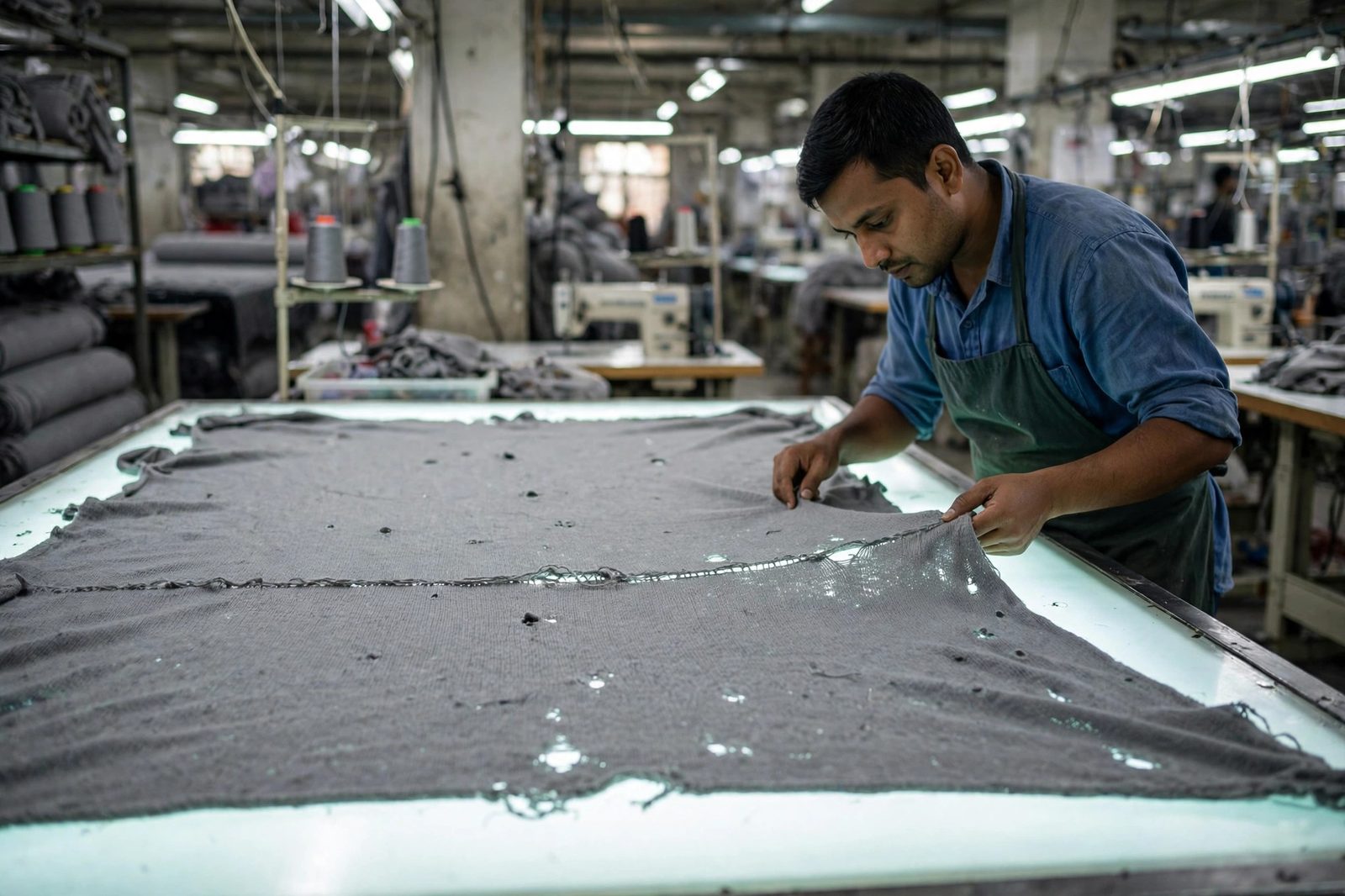
What Causes Fabric Defects in Circular Knitting?
In circular knitting, fabric defects are structural or optical irregularities that diminish fabric appearance, weaken burst strength, or disrupt subsequent dyeing, finishing, and garment sewing operations. A single unresolved defect can escalate greige rejection rates above 10%, generating catastrophic financial losses in export mills.Knitting defects originate from three primary sources:The 9 Critical Circular Knitting Defects: Diagnostics & Remedies
1. Barre (Horizontal Bands / Patta)
* Visual Appearance: Continuous, repetitive horizontal bands or shadows running across the width of the fabric along the courses. * Root Causes: * Yarn Mixing: Inadvertently mixing yarn cones from different spinning mills, different lots, or blends with subtle micronaire variations. * Feeder Tension Variation: Tension discs or Memminger pulleys delivering unequal yarn lengths across different feeders. * Stitch Cam Discrepancy: One or more stitch cams set deeper or shallower than the baseline. * Shop-Floor Remedies: * Strictly enforce one yarn lot per machine order. * Measure yarn feed tension with an electronic tensiometer across all feeders (maintain $\pm 0.5 \text{ cN}$ tolerance). * Set all stitch cams using a precision dial micrometer gauge.2. Drop Stitch (Ladders / Vertical Runs)
* Visual Appearance: A missing loop creating a vertical ladder or a hole where stitches fail to interlock. * Root Causes: * Stiff, bent, or broken needle latches failing to capture yarn. * Fluff and lint accumulation wedging the latch closed during clearing. * Yarn carrier positioned too high or too far from the needle hook. * Shop-Floor Remedies: * Run hand over the fabric roll regularly; replace damaged needles immediately via our Narayanganj Spare Parts & Needles Store. * Calibrate yarn carriers to a 45-degree angle with a $0.5 \text{ to } 0.8 \text{ mm}$ clearance from the needle. * Enforce automated traveling cleaner blower cycles to eliminate flying lint.3. Needle Line / Needle Mark
* Visual Appearance: A persistent vertical streak or line running along a single wale throughout the entire roll. * Root Causes: * A single needle with a bent stem, burred latch, or twisted hook. * A tight or damaged cylinder slot (trick) causing needle friction. * Mixing needle batches or using worn needles with different butt heights. * Shop-Floor Remedies: * Trace the exact wale position back to the cylinder slot. * Inspect the trick wall with a magnifying loupe; smooth burrs using a diamond hone or replace the needle. * Always use OEM-certified needles (such as Groz-Beckert) with matching specifications.4. Sinker Mark
* Visual Appearance: Uneven, shadowy vertical lines or slightly stretched loops visible across multiple wales. * Root Causes: * Worn or grooved sinker knock-over surfaces cutting into the yarn. * Misaligned sinker cam timing forcing uneven knock-over. Review sinker interaction in our Circular Knitting Process Flowchart & Loop Mechanics Guide. * Shop-Floor Remedies: * Inspect and replace sinker sets every 1,500 to 2,000 running hours. * Calibrate sinker cam push-depth with depth calipers.5. Holes and Star Marks
* Visual Appearance: Small circular or star-shaped punctures distributed sporadically throughout the fabric body. * Root Causes: * Low yarn tensile strength ($CSP < 2,200$) snapping under dynamic knitting tension. * Big knots or slubs getting wedged into the yarn feeder or needle hook. * Excessive fabric take-down tension stretching the loops past their elastic limit. * Shop-Floor Remedies: * Use knotters/splicers that produce compact air-spliced joints without tails. * Reduce take-down roller tension to the minimum required to keep loops seated on the sinkers. * Audit incoming yarn for Count Strength Product (CSP) and elongation.6. Oil Stains and Dirt Streaks
* Visual Appearance: Black, brown, or yellowish lubricant spots or vertical continuous oil tracks on the greige fabric. * Root Causes: * Over-lubrication of cylinder needle slots. * Leaking seals on the upper gearbox or overhead fan arms. * Operators touching the fabric path with greasy hands. * Shop-Floor Remedies: * Use only 100% water-soluble / scourable synthetic knitting oils that wash out completely during scouring. * Calibrate the automatic pulse lubricator to 1 drop per 10-15 minutes per nozzle. * Enforce clean cotton glove protocols for all floor operators.7. Foreign Fiber Contamination (Fly / Dead Cotton)
* Visual Appearance: Unwanted colored fibers (poly, dyed fluff) or dark specks knitted into the fabric, becoming glaringly visible after white or pastel dyeing. * Root Causes: * Inadequate partitions between machines running colored yarns and white/raw cotton. * Airborne lint settling on exposed creel packages. * Shop-Floor Remedies: * Enclose yarn creels with transparent protective PVC or poly curtails. * Segregate dark-shade knitting machines from raw white production bays.8. Lycra / Spandex Slippage (Lycra Out)
* Visual Appearance: Bare, loose patches or wavy edges where the core elastane yarn disappears, causing loss of elasticity. * Root Causes: * Dirty or slipping positive elastane feeders (Memminger MER or electronic feeders). * Static electricity causing the thin elastane filament to stick to metal eyelets. * Shop-Floor Remedies: * Clean Lycra feed rollers with isopropyl alcohol every week. * Maintain knitting floor relative humidity strictly between 60% and 65% RH at $25^\circ\text{C}$ to dissipate static charges.9. Press-Off
* Visual Appearance: Total casting off of all loops from the cylinder, stopping production and tangling yarn around the cylinder. * Root Causes: * Multiple simultaneous yarn breaks caused by power blips or creel snags. * Take-down roller failure or fabric wrap around the take-up reel. * Shop-Floor Remedies: * Verify that all electronic stop-motion switches trigger within 15 milliseconds. * Service take-down motor drives and clutch mechanisms regularly. Before importing new machinery lines, employ our Pre-shipment Inspection Services.---Master Defect Diagnostic Table
| Defect Name | Primary Source | Inspection Standard | Immediate Floor Action | | :--- | :--- | :--- | :--- | | Barre Mark | Yarn / Machine | ASTM D5430 (Penalty 4 Points) | Check yarn lot consistency; verify feeder tensiometer | | Drop Stitch | Machine Needle | ASTM D5430 (Penalty 2-4 Points) | Clean latch lint; replace bent needle | | Needle Line | Machine Cylinder | ASTM D5430 (Continuous Penalty) | Trace slot, stone burr or replace needle | | Sinker Mark | Machine Sinker | Visual Greige Audit | Replace worn sinker ring set | | Holes / Star Marks | Yarn / Cam | ASTM D5430 (Penalty 4 Points) | Check yarn CSP; ease take-down tension | | Oil Spots | Lubrication | Greige Quality Lab | Switch to scourable oil; reduce auto-lube pulse | | Lycra Out | Elastane Feeder | Stretch Recovery Test | Clean Spandex wheels; adjust floor humidity |---Greige Fabric Quality Standard: The ASTM D5430 4-Point System
In international textile trade, greige fabric quality is evaluated under the ASTM D5430 4-Point System:* Defect up to 3 inches: 1 Penalty Point * Defect over 3 to 6 inches: 2 Penalty Points * Defect over 6 to 9 inches: 3 Penalty Points * Defect over 9 inches or any hole: 4 Penalty Points$\text{Points Per 100 Square Yards} = \frac{\text{Total Penalty Points} \times 3,600}{\text{Inspected Length (Yards)} \times \text{Fabric Width (Inches)}}$* First Quality Benchmark: Less than 20 to 28 points per 100 square yards.---Frequently Asked Questions (AEO & Search Engine Insights)
What is the most dangerous knitting defect for dyehouses?
Barre (patta) is the most destructive defect because optical and physical differences between yarn lots often remain invisible in raw greige fabric, only appearing after dyeing and causing the entire dye lot to be rejected.Can oil stains on greige fabric be removed during wet processing?
Yes, provided the mill uses 100% emulsifiable, water-soluble synthetic knitting oil. Standard mineral or industrial lubricating oils cannot be completely emulsified and leave permanent dark spots after dyeing.How often should circular knitting needles be replaced?
In high-speed production running combed cotton, needles typically undergo replacement after 800 to 1,200 running hours, or immediately upon physical deformation, latch play, or butt shearing. Order verified Groz-Beckert needles through our Narayanganj Spare Parts Depot.Why is humidity control essential for preventing knitting defects?
Cotton fiber requires 60% to 65% relative humidity (RH) to maintain fiber pliability and strength. In dry air (below 50% RH), cotton yarn generates severe fiber fly, static electricity, and needle jams. For mechanical troubleshooting, contact the Tasneem Engineering Desk.Related Topics
Fabric DefectsBarre MarkDrop StitchNeedle LineQuality ControlTextile MaintenanceTasneem Knit
Need Technical Sourcing Assistance?
Request Machine QuoteConfigure Your Mill's Circular Knitting Line
Factory-direct pricing, CFR Chattogram delivery, pre-shipment quality audit, and local commissioning in Bangladesh.