
Maintenance & Parts•2026-10-21•Tasneem Editorial Desk
Circular Knitting Machine Preventive Maintenance Schedule for Bangladesh Factories
Breakdowns don't schedule appointments — your maintenance should. This guide gives Bangladesh knitting factories a practical daily, weekly, monthly and annual preventive maintenance schedule for circular knitting machines, with operator checks, lubrication discipline and a service logbook.
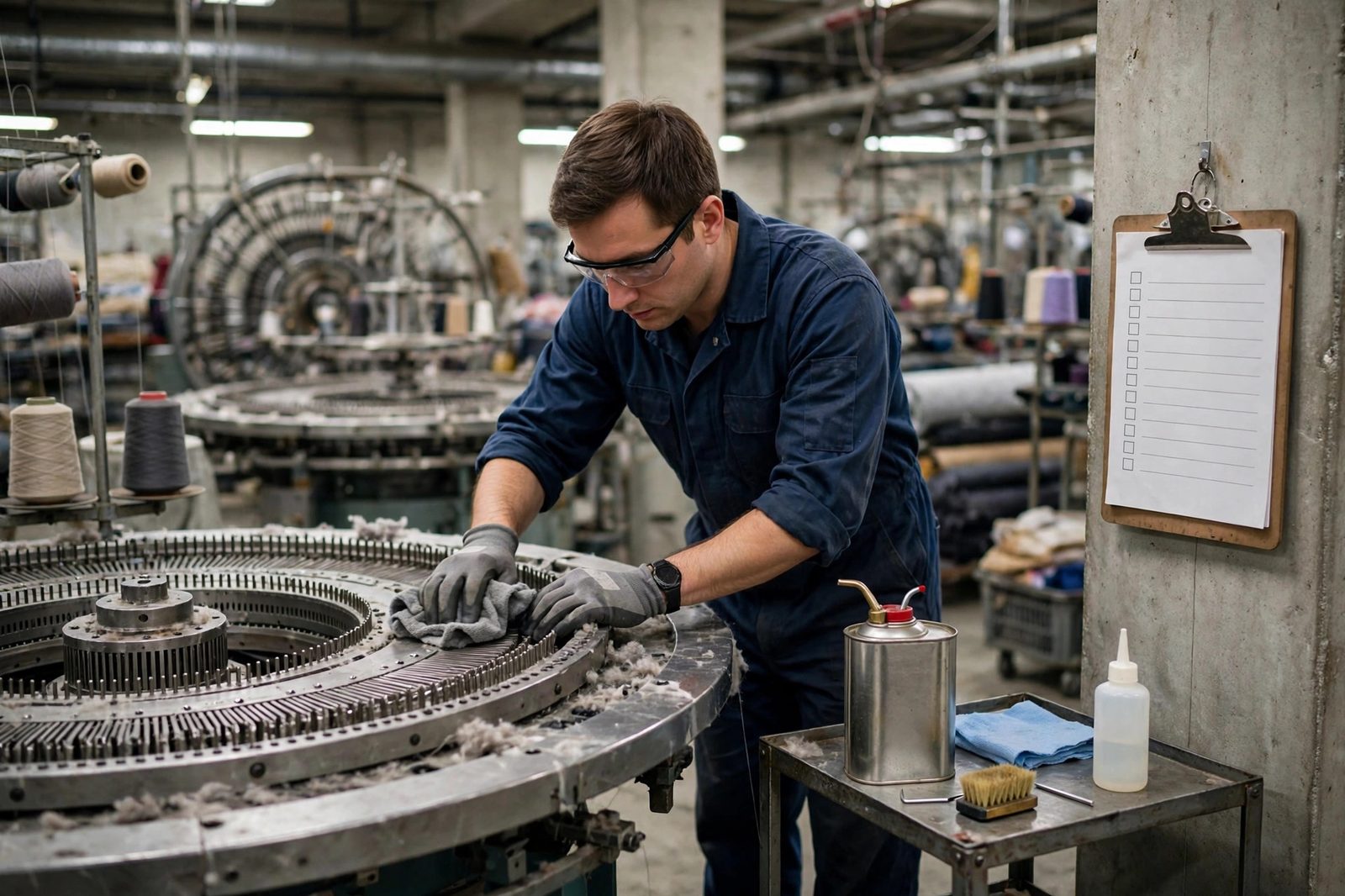
Direct answer: A preventive maintenance schedule for a circular knitting machine is a written plan that assigns every care task — daily cleaning, weekly lubrication, monthly deep inspection, and annual overhaul — to a fixed interval and a responsible person. Done consistently, it cuts unplanned stoppages, keeps fabric quality steady, extends needle and sinker life, and protects the machine's long working life.Clean lint and fiber residue from needle beds, yarn feeders, tension discs and take-down rollers with a soft brush or compressed air. Accumulated lint is the main cause of blocked yarn paths and false stop-motion signals.
Visually inspect needles, sinkers and cams for bent, broken or worn elements and replace them immediately — a single broken needle marks every course it passes through. Our fabric defect troubleshooting guide shows which faults each worn part produces.
Check yarn tension at the feeders and confirm tension discs are set to the current yarn specification — tension drift is the quietest cause of barré.
Check oil and lubrication levels at the start and end of each workday; low oil starves the cylinder and cam tracks.
Confirm the compressed air supply and electrical panel indicators are normal before the first revolution of the day.
Keep the production area dust-free — surrounding lint settles back onto the machine as fast as you clean it. Lubricate moving parts with the manufacturer-approved oil or grease — needle beds, bearings and critical moving components. The standing rule is balance: too little oil accelerates wear, too much attracts dust and creates oil spots on the fabric (xmnyuanda.com; insights.made-in-china.com).
Thorough cleaning beyond the daily routine — remove lint from internal areas, cams and lubrication points.
Inspect needles and sinkers more closely, checking latch and spring action, and test tension adjustments across feeders for consistency.
Check drive belts and chains for wear, cracks or looseness; a stretched belt loses RPM and shows up as lost production.
Inspect electrical connections and wiring for heat damage or loose terminals. Weekly work is usually done by the shift technician. Record everything — the logbook discipline described below is what turns weekly care into a system.Full inspection of all moving parts — deep clean and check every moving component, replacing anything showing wear before it fails (insights.made-in-china.com).
Electronic components and sensors — verify stop motions, yarn-break sensors and proximity switches; sensors that fail silently let the machine knit defective fabric for hours (circularknittingmachine.com).
Drive system — belt and chain tension, gearbox oil, motor bearings.
Safety features — guards, emergency stops, overload protection.
Lubrication distribution system — confirm oil reaches every lubrication point; clean or replace clogged lines and oil filters. Factory-level maintenance guides recommend conducting a full machine audit monthly and documenting all maintenance activities (circularknittingmachine.com). A monthly audit that finds one worn cam before it damages a thousand needles has paid for itself.Quarterly: deep clean internal components, replace belts and hoses showing age, inspect pulleys, shafts and bearing housings, and treat corroded surfaces.
Annually: a full machine overhaul — professional servicing of the cylinder, cam tracks, drive system and electronics. Annual guidance from machine-maintenance sources consistently calls for comprehensive servicing by trained technicians (insights.made-in-china.com). Treat the annual overhaul as the year's quality insurance: it resets the wear clock and catches the faults that daily care cannot see. Align the annual overhaul with your low season or a planned shutdown so it never competes with order delivery.Date, shift and technician for every task completed
Parts inspected, adjusted or replaced — with batch numbers for needles and sinkers
Operating hours and the machine's running parameters at each service
Any defect or abnormal noise found, and the corrective action taken Over a year, these records reveal each machine's true wear pattern: which feeder's needles fail first, how fast belts stretch, when oil consumption rises. That history lets you tune the schedule to your own factory instead of relying on generic intervals — and it is the evidence your spare parts inventory planning depends on for reorder points.Only fixing breakdowns — reactive maintenance costs more in downtime, rejected fabric and emergency parts than any preventive plan.
Skipping the logbook — undocumented maintenance cannot be reviewed, and wear patterns stay invisible.
Over-lubrication — excess oil attracts dust and ends up as oil spots in the fabric; follow the maker's dosage.
Using unapproved oils or skipping grades — wrong lubricants damage seals and cam tracks.
No named owner per interval — "someone should do it" means nobody does it. Assign each interval to a role and review compliance monthly.
Why a preventive maintenance schedule matters
A circular knitting machine has thousands of precision parts working at speed — needles, sinkers, cams, feeders, belts and drives. When any of them wears beyond tolerance, the machine does not stop politely: it knits the fault into kilometres of fabric. Research on on-line fabric defect detection found that the most common and serious defects — needle lines, dropped stitches, holes and oil spots — dominate what goes wrong, which means a machine that knits a fault keeps producing reject-grade fabric until someone notices (Fibre2Fashion). A written schedule moves the factory from reactive repair — fixing what already broke — to preventive care: finding wear during a planned stop instead of discovering it in a rejected roll. The industry keeps investing in new machines — ITMF's 48th annual International Textile Machinery Shipment Statistics recorded about 24,500 large circular knitting machines shipped worldwide in 2025 (ITMF ITMSS 2025, reported July 2026) — so protecting each machine's productive life is protecting capital.Daily checks: the operator's ten minutes
Daily care belongs to the operator, at shift start and shift end. It takes minutes and prevents most sudden failures. Machinery maintenance guidance for circular knitting machines converges on the same core daily list (xmnyuanda.com; insights.made-in-china.com; circularknittingmachine.com):Weekly maintenance: lubrication and adjustment
Once a week, go deeper than the operator's daily list:Monthly maintenance: the full audit
Once a month, audit the whole machine:Quarterly and annual: deep clean and overhaul
Some care cannot fit into a production rhythm:Service records: the logbook that makes it work
A schedule without records is a wish. Keep one service log per machine, recording:Five mistakes that break the schedule
FAQs
How often should a circular knitting machine be serviced? Daily: clean, inspect needles/sinkers/cams, check tension and oil levels. Weekly: lubricate, thorough cleaning, closer needle inspection, belt and electrical checks. Monthly: full audit including electronics and sensors. Annually: professional overhaul. Adjust frequency upward for continuous-operation machines and dusty environments.Can operators do maintenance, or does it need a technician? Daily checks are operator work — cleaning, visual inspection and tension checks take minutes per shift. Weekly and monthly tasks belong to trained technicians, and the annual overhaul should involve professional service engineers. Training operators to spot early warning signs is the single most effective maintenance investment a mill can make.What happens if a knitting machine runs without preventive maintenance? Wear accumulates silently: needles break, cams score, belts stretch, oil degrades. The machine keeps knitting faults into the fabric — needle lines, dropped stitches, holes and oil spots — until a breakdown stops it. The cost is lost production, rejected rolls and emergency repairs, all preventable by the daily-weekly-monthly discipline above.How do I start a preventive maintenance schedule in an old factory? Begin with a one-month baseline: daily operator checks plus a single monthly audit on every machine, all logged. The logbook will show which machines need more frequent care. Then layer in weekly lubrication and quarterly deep cleaning, and schedule the first annual overhaul in the next planned shutdown.Related Topics
preventive maintenancecircular knitting machinemaintenance schedulelubricationneedlesপ্রতিরোধমূলক রক্ষণাবেক্ষণনিটিং মেশিন রক্ষণাবেক্ষণকারখানা দক্ষতা
Need Technical Sourcing Assistance?
Request Machine QuoteConfigure Your Mill's Circular Knitting Line
Factory-direct pricing, CFR Chattogram delivery, pre-shipment quality audit, and local commissioning in Bangladesh.