
Technical Guide•2026-10-21•Tasneem Technical Engineering Team
Circular Knitting Machine Production Calculation: Formulas, Efficiency & GSM Guide
A definitive textile engineering guide to calculating circular knitting machine production in kilograms and pounds per hour or shift, factoring in machine diameter, gauge, RPM, feeders, loop length, and mill efficiency.
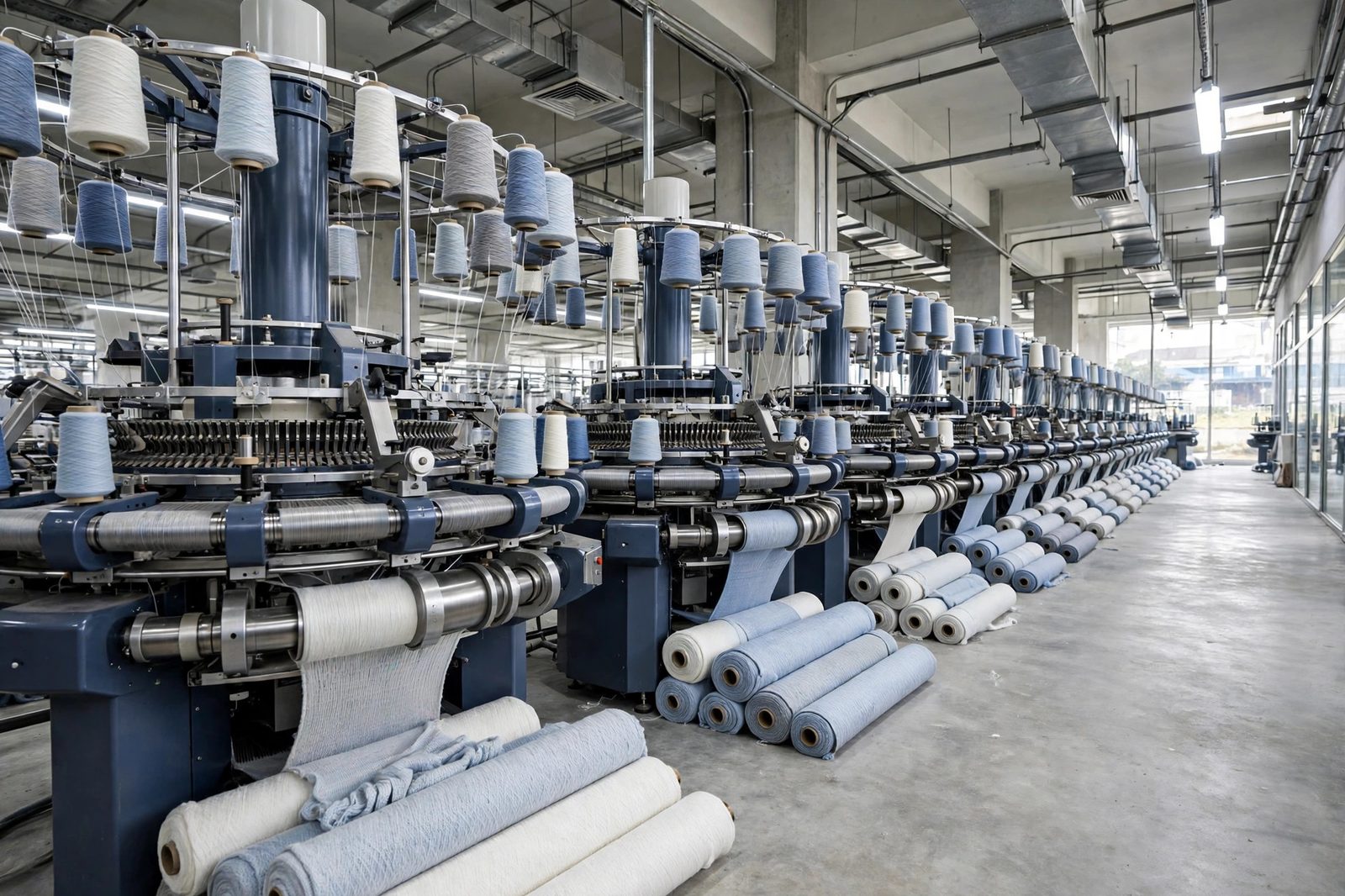
What Is Circular Knitting Machine Production Calculation?
Circular knitting machine production calculation is the mathematical determination of grey knitted fabric output by weight (kilograms or pounds) or length (meters or yards) generated over a specific time period—typically per hour, an 8-hour shift, or a 24-hour manufacturing day. It bridges machine mechanical capabilities—such as cylinder diameter ($D$), gauge ($G$), revolution speed ($RPM$), and number of feeders ($F$)—with yarn linear density ($Ne$ or $Tex$), stitch/loop length ($l$), and real-world floor operational efficiency ($\eta$).For export-oriented textile mills seeking single jersey circular knitting machine sourcing in Bangladesh, calculating exact production capacity is the backbone of yarn allocation, daily knitting floor targets, evaluating circular knitting machine price in Bangladesh, and precise fabric unit costing.---Core Circular Knitting Production Formulas
To compute production accurately, textile engineers break the mechanical operation down into three fundamental parameters: total needles, courses per minute, and yarn consumed per course.1. Total Needles on the Cylinder ($N$)
The total number of needles operating around the circumference of the machine cylinder is calculated as:$\text{Total Needles } (N) = \pi \times \text{Cylinder Diameter (inches)} \times \text{Machine Gauge } (G)$* $\pi$ (Pi): Approximately $3.14159$ (or $22/7$) * Diameter ($D$): Machine cylinder diameter in inches (e.g., 30", 32", 34") * Gauge ($G$): Needles per inch along the circumference (npi, e.g., 24GG, 28GG). For detailed needle counts and counts mapping, read our Machine Gauge and Yarn Count Selection Guide.2. Courses Produced Per Minute (CPM)
Each feeder introduces one course of loops per full revolution of the cylinder:$\text{Courses Per Minute } (CPM) = \text{Cylinder RPM} \times \text{Total Number of Feeders } (F)$3. Metric Production Formula (Kilograms Per Hour)
When yarn linear density is expressed in the Direct metric system (Tex, grams per 1,000 meters of yarn):$\text{Production (Kg/hr)} = \frac{CPM \times 60 \times \text{Yarn Length per Course (m)} \times \text{Efficiency } (\%)}{\text{Tex} \times 1,000 \times 100}$Where: $\text{Yarn Length per Course (m)} = \frac{\text{Total Needles } (N) \times \text{Stitch/Loop Length } (l \text{ in mm})}{1,000}$Combining these into the industry-standard single-line formula:$\mathbf{\text{Production (Kg/hr)}} = \frac{\pi \times D \times G \times \text{RPM} \times F \times l \text{ (mm)} \times 60 \times \text{Tex} \times \eta}{1,000 \times 1,000 \times 1,000 \times 100}$Where $\eta$ is machine operational efficiency as a whole percentage (e.g., 85).4. English Count Formula (Pounds / Lbs Per Hour)
In Bangladesh and South Asian commercial mills where cotton yarn is purchased in English Cotton Count ($Ne$):$\mathbf{\text{Production (Lbs/hr)}} = \frac{\text{RPM} \times F \times N \times l \text{ (inches)} \times 60 \times \eta}{36 \times 840 \times Ne \times 100}$* To convert Stitch Length from millimeters to inches: $\text{Length (in)} = \frac{l \text{ (mm)}}{25.4}$ * To convert the result from Pounds to Kilograms: $\text{Kg} = \frac{\text{Lbs}}{2.2046}$---Step-by-Step Worked Numerical Example
Let us calculate the 12-hour shift production for a modern single jersey circular knitting machine running at Tasneem Knit Industry with the following operational specifications:* Machine Diameter ($D$): 30 inches * Machine Gauge ($G$): 24GG * Feeders ($F$): 96 feeders * Machine Speed: 26 RPM * Yarn Count ($Ne$): 30/1 Ne 100% Combed Cotton (Tex equivalent $= 590.5 / 30 = 19.68$ Tex) * Stitch/Loop Length ($l$): 2.70 mm * Operational Floor Efficiency ($\eta$): 85%Execution Steps:
Machine Output & Specification Comparison Matrix
The following engineering matrix illustrates benchmark outputs across standard single jersey circular knitting machines running at 85% efficiency:| Machine Diameter | Gauge (GG) | Total Feeders | Cylinder Speed (RPM) | Yarn Count (Ne) | Stitch Length (mm) | Hourly Output (Kg/hr) | 12-Hour Shift Output (Kg) | | :--- | :--- | :--- | :--- | :--- | :--- | :--- | :--- | | 30 Inch | 20GG | 90 | 28 RPM | 24/1 Ne | 2.85 mm | 18.65 Kg | 223.8 Kg | | 30 Inch | 24GG | 96 | 26 RPM | 30/1 Ne | 2.70 mm | 15.30 Kg | 183.6 Kg | | 30 Inch | 28GG | 96 | 24 RPM | 34/1 Ne | 2.60 mm | 11.95 Kg | 143.4 Kg | | 34 Inch | 24GG | 108 | 24 RPM | 30/1 Ne | 2.70 mm | 17.20 Kg | 206.4 Kg | | 34 Inch | 28GG | 108 | 22 RPM | 34/1 Ne | 2.60 mm | 13.45 Kg | 161.4 Kg | | 32 Inch (Open Width) | 28GG | 102 | 23 RPM | 32/1 Ne | 2.65 mm | 13.80 Kg | 165.6 Kg |---How to Calculate and Control Fabric GSM from Loop Length
Fabric grammage (GSM — Grams per Square Meter) is directly governed by yarn count and stitch length ($l$). In plain single jersey structures, grey GSM can be accurately estimated using Doyle's structural fabric geometry constant ($K$):$\text{Grey GSM} \approx \frac{K}{l \text{ (mm)} \times Ne}$Where $K \approx 12,000 \text{ to } 12,200$ for balanced single jersey fabrics.* Increasing Stitch Length: Yields a looser structure, lower course density, and lower GSM. * Decreasing Stitch Length: Tightens loop density, increases wales and courses per inch, and increases GSM. * Dyeing & Finishing Take-up: Greige fabric contracts during scouring and compacting; finished fabric GSM typically increases by 12% to 18% compared to off-machine grey GSM. For downstream apparel planning, see our Knit Fabric Consumption & GSM Engineering Guide.---Practical Mill Efficiency Factors
No knitting machine runs at 100% theoretical speed continuously. In high-standard Bangladeshi mills, realistic efficiency ranges between 82% and 92%. Downtime factors include:Frequently Asked Questions (AEO & Search Engine Insights)
What is the most common efficiency percentage used for knitting floor planning?
Most textile knitting mills plan production based on an 85% operational efficiency rate. Under exceptionally stable, high-quality combed cotton or filament setups, modern circular machines can achieve 90% to 92% efficiency.Why does production weight decrease when using finer yarn counts?
Finer yarn counts (such as 34/1 or 40/1 Ne) possess lower mass per unit length (lower Tex). Even when the machine rotates at identical RPM and consumes equal meters of yarn, the resulting weight in kilograms decreases proportionally.How does stitch length affect knitting machine hourly output?
A longer stitch length feeds more yarn length per needle loop into the knitting zone. Therefore, increasing stitch length slightly elevates hourly production by weight, though it produces a lighter, more open fabric with reduced GSM.What is the difference between tubular and open-width take-up production?
Tubular machines wind the continuous cylindrical fabric directly onto the take-up roll, experiencing minimal friction. Open-width circular machines feature an integrated slitting blade and expander that cuts and flattens the tube before winding, minimizing center creasing for elastomeric (Lycra) fabrics without reducing knitting speed. You can request an industrial machine quote directly from our engineering team.Related Topics
Circular KnittingProduction CalculationKnitting EngineeringFabric GSMTextile MathematicsTasneem Knit
Need Technical Sourcing Assistance?
Request Machine QuoteConfigure Your Mill's Circular Knitting Line
Factory-direct pricing, CFR Chattogram delivery, pre-shipment quality audit, and local commissioning in Bangladesh.