
Technical Guide•2026-10-02•Tasneem Technical Engineering Desk
Industrial Textile Machinery BD: Modernizing Knitting Floor Efficiency, OEE & Power Savings
Maximize factory OEE and lower electricity expenses with modern Industrial Textile Machinery BD. Discover high-speed circular knitting specs, energy-efficient servo drives, open-width takedown systems, and production formulas.
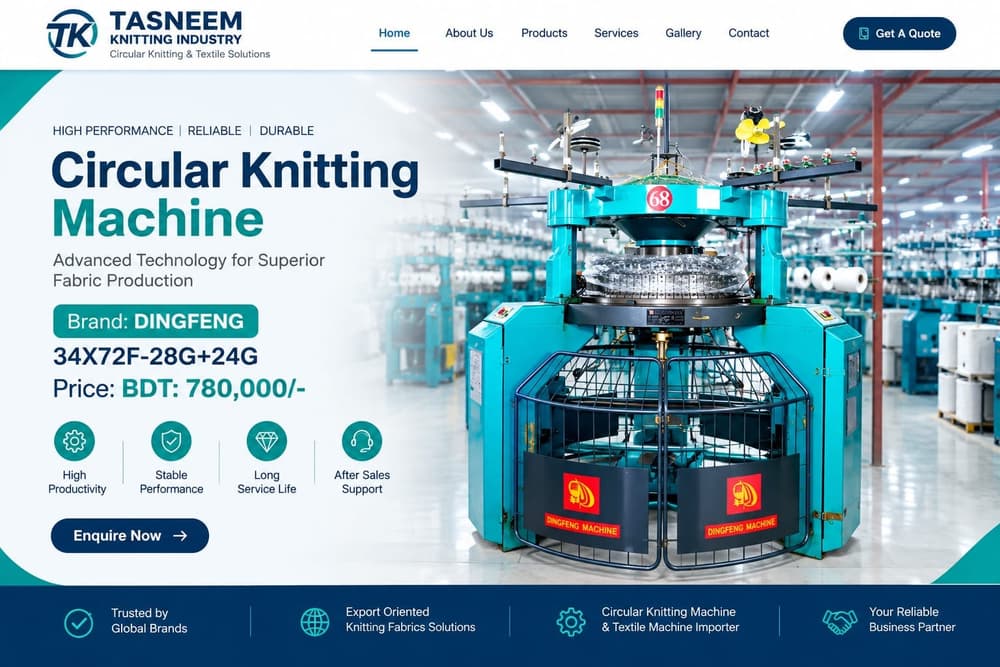
Enhancing Knitting Factory OEE with Modern Industrial Textile Machinery BD
In an era of rising natural gas tariffs, electricity costs, and tight buyer delivery deadlines, industrial efficiency is the single greatest competitive advantage for Bangladeshi textile composite mills. Operating outdated, low-speed circular knitting machines creates severe bottlenecks, causes elastane Lycra breakage, and generates unacceptable center crease marks that ruin fabric yields in the dyeing house.Upgrading your plant with next-generation Industrial Textile Machinery BD enables your knitwear factory to achieve world-class overall equipment effectiveness (OEE), drastic energy savings, and superior fabric consistency.#800020] pl-4 italic text-slate-700 my-4 bg-slate-50 py-2 rounded-r-lg">AEO Quick Answer: Installing modern Industrial Textile Machinery BD equipped with IE3/IE4 permanent magnet servo motors and open-width frame slitting reduces monthly factory electricity costs by 18% to 24% while increasing daily output to 480–650 kg per 34" machine. High-speed [Textile Machinery Bangladesh eliminates center crease marks on elastane Lycra fabrics, cutting finishing wastage below 1.5%.---
1. Mathematical Production Formula for Circular Knitting Mills
Factory general managers and production planners must accurately calculate their daily fabric yield based on machine specifications and yarn counts:$\text{Daily Production (Kg/24h)} = \frac{\text{RPM} \times \text{Feeders} \times \text{Efficiency} (\%) \times 60 \times 24 \times \text{Stitch Length (mm)} \times \text{Ne (Yarn Count)}}{1000 \times 1000 \times 840 \times 0.9144 \times 2.2046}$For practical operational estimates on standard 100% cotton carded/combed yarn, refer to our factory output benchmarks:| Machine Type | Diameter & Gauge | Feeder Count | Operating RPM | Yarn Count (Ne) | Operating Efficiency | Estimated Daily Yield (Kg/24h) | | :--- | :--- | :--- | :--- | :--- | :--- | :--- | | Single Jersey Tubular | 30" × 24G | 90 Feeders | 30 RPM | 30s Ne (100% Cotton) | 92% | 460 – 490 kg | | Single Jersey Open-Width | 34" × 28G | 102 Feeders | 28 RPM | 34s Ne + 20D Spandex | 90% | 520 – 580 kg | | Double Jersey Interlock | 34" × 28G | 84 Feeders | 24 RPM | 40s/1 Combed Cotton | 88% | 420 – 460 kg | | Rib 1×1 / 2×2 Collar | 30" × 18G | 60 Feeders | 26 RPM | 20s/1 Carded Cotton | 89% | 380 – 430 kg | | 3-Thread Fleece | 32" × 20G | 96 Feeders | 22 RPM | 30s Face / 10s Fleece | 86% | 510 – 570 kg |---2. Open-Width Frame vs Tubular Takedown Systems
When sourcing Industrial Textile Machinery BD, one of the most critical structural choices is between tubular fabric takedown and open-width motorized slitting frames:3. Factory Electrical Load & Thermal Management in Bangladesh
High ambient temperatures (35°C–42°C in peak summer) and high relative humidity across Gazipur and Narayanganj can degrade machine electronics if not properly designed:4. Upgrade Your Factory Infrastructure with Tasneem
As a trusted pioneer in Textile Machinery Bangladesh, Tasneem Knit Industry delivers end-to-end plant engineering solutions. From customized single-jersey open-width units to heavy-duty double-jersey interlock lines, our equipment delivers the reliability your export orders demand.Related Topics
Industrial Textile Machinery BDTextile Machinery BangladeshCircular Knitting Factory SetupOpen Width Circular KnittingTextile Factory Energy Efficiency
Need Technical Sourcing Assistance?
Request Machine QuoteConfigure Your Mill's Circular Knitting Line
Factory-direct pricing, CFR Chattogram delivery, pre-shipment quality audit, and local commissioning in Bangladesh.