
Maintenance & Parts•2026-10-22•Tasneem Editorial Desk
Knitting Needle and Sinker Replacement Guide for Bangladesh Mills
Worn needles and sinkers downgrade every roll they touch. This guide shows how to spot wear symptoms, inspect hooks and latches, replace parts safely, keep batch consistency, and know when the cam track is the real problem.
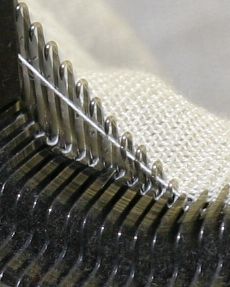
Knitting Needle and Sinker Replacement Guide for Bangladesh Mills
Direct answer: Replace circular knitting machine needles and sinkers when you see repeated fabric holes, needle lines, or latch stiffness — waiting turns a single worn needle into fabric downgrade across every roll. Inspect needles under magnification weekly, replace broken or bent needles immediately, and inspect the cylinder and cam track whenever breakage recurs. Most mills schedule full needle checks every 3–6 months.Why needles and sinkers fail first
In a circular knitting machine, the latch needle and the sinker are the only parts that touch the yarn on every single loop. On a 30-inch, 28-gauge machine running export orders, each needle opens and closes its latch tens of thousands of times per shift. Friction, heat, and mechanical shock make needles and sinkers the highest-wear components on the machine — a point the industry maintenance references agree on (see the Complete Maintenance and Troubleshooting Guide).A needle can be described simply: it is a knitting element with a pivoted latch that opens to take the yarn and closes to pull the loop through the old stitch. A sinker is a thin steel plate that holds the old loop down while the needle rises, then assists loop knock-over. When either part loses its precise geometry, the machine keeps running — but the fabric stops being right.Needle wear symptoms you can see in the fabric
Worn needles announce themselves through the fabric long before the operator sees the steel:Sinker wear symptoms
Sinkers wear more slowly but fail more subtly:Inspection points before every replacement
Good replacement starts with disciplined inspection. Work through these checks in order:Safe replacement practice
Replacing a needle or sinker is a two-minute job done wrong in thirty seconds. Follow the safe sequence:Batch consistency matters more than brand price
Never mix needle brands or specifications on the same machine — incompatible hardness, hook profile, or latch timing puts uneven stress on the batch and accelerates failure (circularknittingmachine.com). Keep replacement stock matched to the machine's specified needle type, and prefer changing a full feeder line or section when wear is uniform rather than spot-replacing scattered singles. Log the batch or lot number of each set so a premature failure can be traced. Our spare parts inventory guide shows how to size needle and sinker stock so replacements are always on hand without tying up cash.Recordkeeping: track life by operating hours
The most useful needle record is operating hours per set, not calendar days. Record the set installation date, machine, gauge, cumulative running hours, yarn types run, and the reason for removal (wear, breakage, planned change). Over a year this log reveals the true lifespan of needles on each machine and yarn — the basis for planned replacement budgets and for spotting machines that eat needles, which usually points to a cam or lubrication problem rather than bad needles.When to inspect the cylinder and cam track
Recurring needle breakage in the same feeder zone is not a needle problem — it is a cam or cylinder problem. The cam track sets the needle's rise and fall; a worn or chipped cam track hammers every needle that passes it, so new needles break the same way the old ones did. When breakage repeats:How often should needles and sinkers be replaced?
Industry practice converges on a manufacturer-guided cycle of roughly every 3–6 months for full needle inspection on continuously running export machines, with broken or deformed parts replaced immediately on detection (vietextile.com). Sinkers typically run longer, but inspect them on the same cycle. The right interval for your mill comes from your own hour-log: once you know how many running hours a set survives on your main yarn and gauge, set the planned change just short of that number and let the log, not the calendar, decide.Spare-needle storage
New needles rust before they wear out if stored badly. Keep spares in their original packaging in a dry, temperature-controlled store; ISO 139 defines the standard textile testing atmosphere at 20 ± 2 °C and 65 ± 4 % relative humidity, and spare-needle storage should approach those conditions. For machines stopped longer than a few days, oil the needle circle with anti-rust oil.Related reading
FAQs
Q1: How do I know whether a fabric defect comes from a bad needle or a bad sinker? A needle fault repeats in the same wale — one vertical column of damage on every course. A sinker fault distorts loop geometry across neighboring stitches and often shows as alternating tight and loose loops. When in doubt, change the suspect needle first; needle replacement is the cheaper test.Q2: Can I keep running if only one needle is broken? Only until the next stop. A broken hook tears formed loops, and the sharp edge damages neighboring needles and sinkers as it rotates. Change it at the next planned stop — never let it ride through a full shift.Q3: Why do new needles keep breaking in the same feeder? Repeated breakage at one position points to the cam track, the cam-cylinder gap, or a chipped sinker plate in that zone — not to the needles. Inspect and fix the track before fitting another new set.Q4: Is it acceptable to mix needle brands on one machine? No. Different brands differ in hook profile, latch timing, and hardness; mixing them creates uneven mechanical stress and premature failure. Standardize one specification per machine and log batch numbers for traceability.Related Topics
knitting needlessinker replacementcircular knitting maintenanceneedle wear symptomsসার্কুলার নিটিং মেশিননিডল পরিবর্তনসিংকার
Need Technical Sourcing Assistance?
Request Machine QuoteConfigure Your Mill's Circular Knitting Line
Factory-direct pricing, CFR Chattogram delivery, pre-shipment quality audit, and local commissioning in Bangladesh.