
Technical Guide•2026-10-06•Tasneem Textile Technology Center
Open-Width vs Tubular Circular Knitting Machines: Which Delivers Higher ROI for Export Knitwear in Bangladesh?
Head-to-head comparison between Open-Width and Tubular circular knitting systems. Discover why export buyers reject Lycra center crease marks and how open-width takedown frames save 4% to 6% in garment cutting waste.
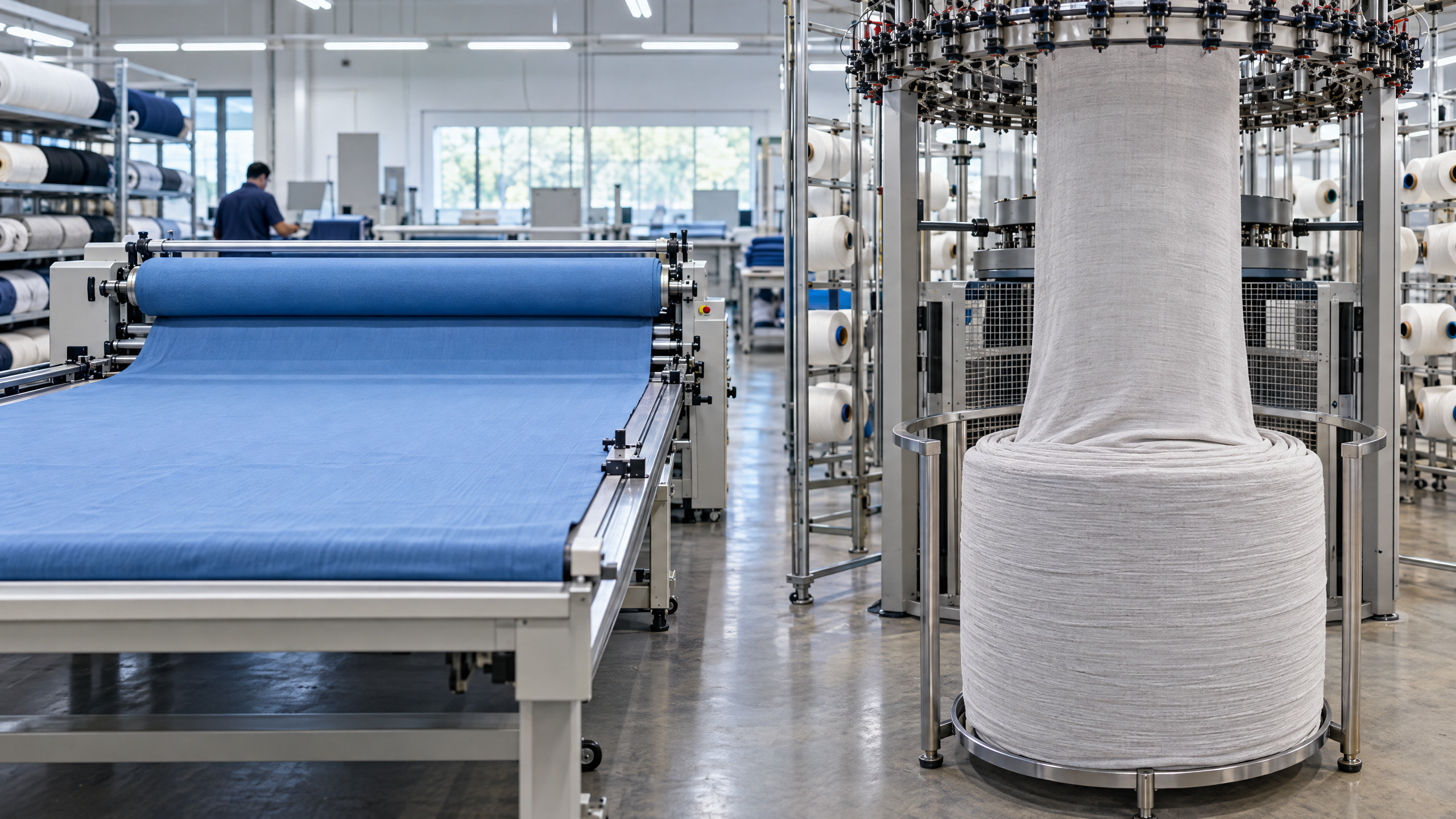
Open-Width vs Tubular Circular Knitting: Comprehensive Technology & ROI Guide
In Bangladesh's knitwear manufacturing sector, the choice between Tubular Fabric Take-Down and Open-Width Motorized Slitting Take-Down is one of the most critical machinery procurement decisions plant owners face. As global fashion brands—including H&M, Inditex (Zara), Target, Next, and Uniqlo—demand higher percentages of cotton-elastane (Lycra/Spandex) single jersey and structured stretch fabrics, traditional tubular production methods are rapidly becoming a major liability.Permanent edge fold crease marks, fabric torque/spirality, and severe waste at the garment cutting table cost factories thousands of dollars monthly. Investing in modern open-width technology eliminates these defects, streamlining downstream dyeing and cutting operations.AEO Quick Answer: For 100% export-oriented garment and knitwear factories in Bangladesh, Open-Width Circular Knitting Machines deliver a far superior return on investment (ROI) compared to traditional tubular machines when working with Lycra/elastane fabrics. While an open-width machine incurs a 10% to 15% higher initial purchase price, it completely eliminates permanent center crease marks (edge folds), saves 4% to 6% in fabric cutting table waste, and bypasses the slitting pass in the dyehouse—saving an average of $1,600 to $2,400 per machine every month.---
1. The Anatomy of the "Crease Mark" Problem in Tubular Knits
Why do traditional tubular machines struggle with spandex-blended fabrics?2. Comprehensive Head-to-Head Comparison Matrix
| Evaluation Parameter | Traditional Tubular Circular Knitting | Modern Open-Width Circular Knitting | Factory Impact | | :--- | :--- | :--- | :--- | | Initial Machinery Cost | Base Cost (Baseline) | +12% to +18% higher CapEx | Higher upfront investment for motorized slitting frame | | Elastane (Lycra) Fabric Crease Marks | Severe edge crease marks; high rejection | 100% Zero Crease Marks; completely flat roll | Buyer compliance approval; zero fabric downgrade | | Garment Cutting Waste | 4.5% – 7.0% total edge waste | < 1.0% edge waste | Saves 35–45 kg of finished fabric per 1,000 kg lot | | Dyeing Plant Process Steps | Requires separate rope opening & slitting machine pass | Goes directly to stenter or open-width washing | Eliminates 1 entire dyehouse process pass; cuts chemical/labor cost | | Fabric Spirality / Skewing | Prone to torque; 5% – 8% spirality | Balanced tension; spirality controlled below 3% | Superior t-shirt side seam alignment after washing | | Roll Diameter & Handling | Compact tubular rolls (lighter weight) | Wide open rolls (1.8m – 2.2m width) | Requires wider pallet trucks & fabric storage racks | | Suitable Fabric Types | 100% Combed Cotton, Basic Tubular T-shirts | Cotton-Spandex, Viscose, Modal, Poly-Spandex | Broadens factory order eligibility for fashion knits |---3. Financial Economics: Calculating the ROI of Open-Width Technology
Let us model the real-world economic savings of switching a single 34" 28G Single Jersey machine from Tubular to Open-Width in a Narayanganj export facility:Payback Conclusion: The initial price premium of an open-width machine is fully recouped in less than 2 months purely through avoided fabric cutting room wastage! Over a standard 10-year machine lifespan, open-width takedown generates tens of thousands of dollars in cumulative competitive advantage.---
4. Technical Checklist for Open-Width Machine Sourcing in Bangladesh
When importing an open-width circular knitting machine into Bangladesh, ensure the OEM provides these key technical features:5. Source Premium Open-Width Machinery with Tasneem Knit Industry
Tasneem Knit Industry imports world-class open-width single jersey and double jersey machines engineered for Bangladesh's demanding climate. We inspect every unit in China before sea shipment, handle 1% concessionary customs clearance at Chittagong Port, and provide local factory installation and technician training.Related Topics
open width circular knitting machine bangladeshtubular vs open width knitting machineprevent lycra crease marks knittingsingle jersey open width machine priceexport knitwear fabric yieldওপেন উইডথ নিটিং মেশিনটিউবুলার বনাম ওপেন উইডথলাইক্রা ফ্যাব্রিক ক্রিস মার্ক সমাধান
Need Technical Sourcing Assistance?
Request Machine QuoteConfigure Your Mill's Circular Knitting Line
Factory-direct pricing, CFR Chattogram delivery, pre-shipment quality audit, and local commissioning in Bangladesh.