
Import & Compliance•2026-10-20•Tasneem Editorial Desk
Textile Machinery L/C Documents in Bangladesh: The Complete Import Document Guide
An L/C is only as strong as its documents. This guide walks Bangladesh machinery importers through every document in the letter-of-credit chain — from the LCA form and proforma invoice to the bill of lading, inspection certificate and bill of entry — with the mismatches that most often delay payment.
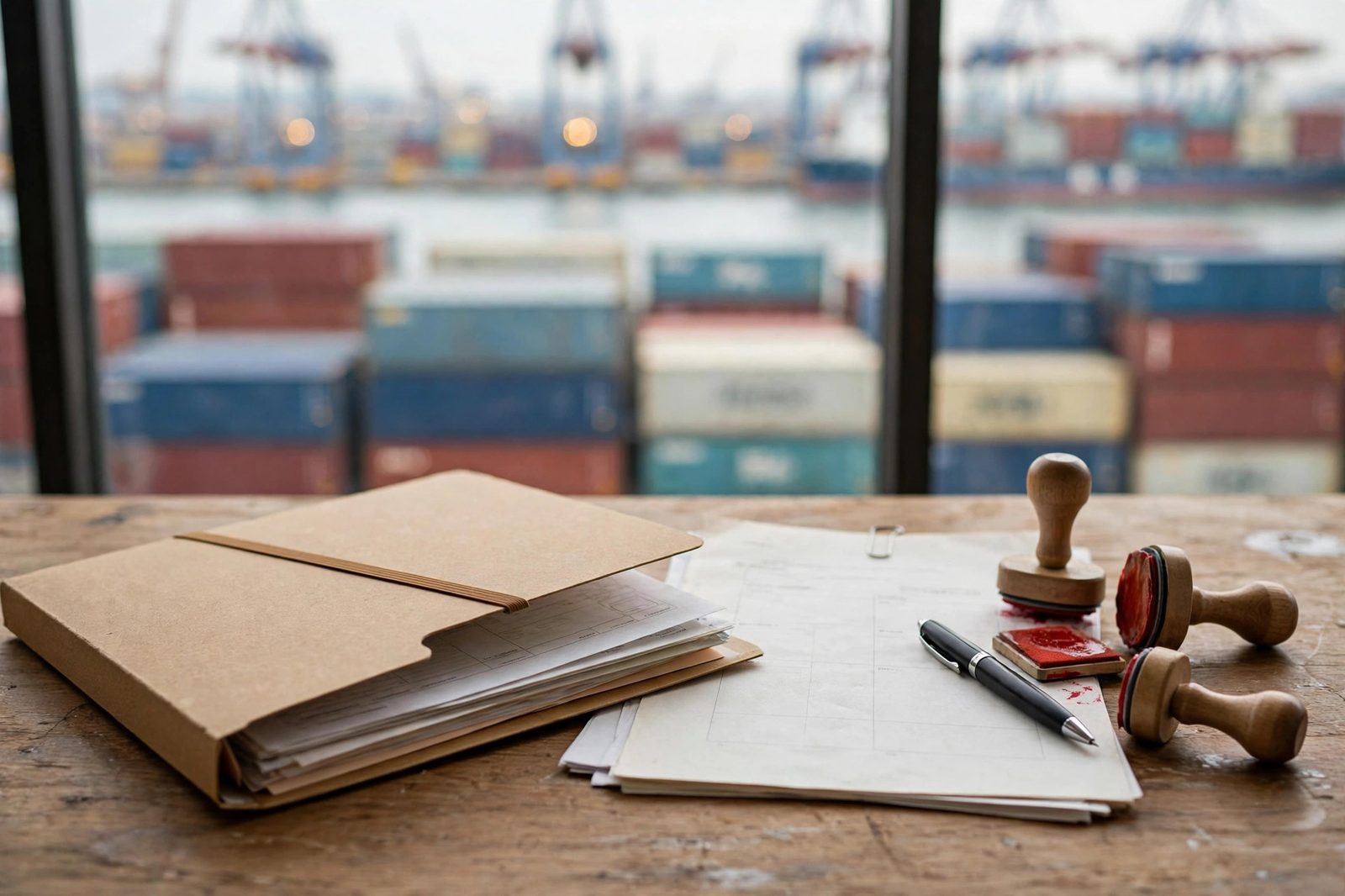
Textile Machinery L/C Documents in Bangladesh: The Complete Import Document Guide
Direct answer: Importing textile machinery into Bangladesh by letter of credit needs a document chain: the LCA form, L/C application, proforma invoice and insurance cover note to open the credit; the invoice, packing list, bill of lading, certificate of origin, insurance policy and inspection certificate to get paid; and the bill of entry with the IMP form to prove the machine arrived. Under ICC UCP 600, banks deal with documents, not goods.Why L/Cs still dominate machinery imports
A letter of credit is a bank's written promise to pay the foreign supplier once the supplier presents documents that comply exactly with the credit's terms. For a circular knitting machine or a dyeing range — a capital purchase that can fund a whole factory line — neither the buyer nor the seller wants to trust a stranger on open account, so the L/C sits between them and substitutes bank risk for commercial risk.The worldwide rulebook is the International Chamber of Commerce's UCP 600 (ICC Publication No. 600, in force since 2007). Its most important sentence is Article 5: "Banks deal with documents and not with goods, services or performance to which the documents may relate." In practice this means your machine can be perfect, but if the bill of lading shows the wrong port spelling, the bank may refuse to pay the supplier until the discrepancy is corrected.How big is this machinery-import pipeline? Bangladesh Bank data reported by The Daily Star showed that in just the first six months of FY2023-24, importers opened L/Cs worth about $1.34 billion for capital machinery, of which roughly $142 million was for garment machinery alone. And the flow continues: the ITMF's 47th annual International Textile Machinery Shipment Statistics (covering 2024) recorded rotor shipments to Bangladesh surging 44% year-on-year — a sign that mills keep investing in equipment even in uncertain years.Stage 1 — Documents you prepare before the L/C is opened
Before any credit exists, your bank's L/C desk (an Authorized Dealer, or AD, under Bangladesh Bank's Foreign Exchange Regulation Act, 1947) will ask for:Stage 2 — Getting the L/C terms right
Once the bank issues the credit, the decisive battle is already half fought or half lost: most discrepancies are born in the L/C text itself, not at the port. Negotiate these points before the credit is issued:Stage 3 — The supplier's document set
To get paid, the beneficiary (your supplier) must present, within validity, a set that typically includes:| Document | What it proves | Checked against | |---|---|---| | Commercial invoice | Final sale price, machine specification | Proforma invoice / L/C amount | | Packing list / weight list | Case count, dimensions, net/gross weight | Bill of lading | | Bill of lading (sea) or airway bill (air) | Shipment made, goods received by carrier | L/C ports, shipment date, consignee | | Certificate of origin | Country of manufacture | Customs preference claims | | Insurance policy / certificate | Cargo insured for the voyage | L/C currency and value | | Inspection certificate | Machine tested to specification | L/C inspection clause | | HS code declaration | Correct customs classification | NBR tariff schedule |For knitting machines, the correct heading is HS 8447 — Bangladesh Customs' tariff schedule lists circular knitting machines under 8447.11.00 (cylinder diameter up to 165 mm) and 8447.12.00 (over 165 mm), flat knitting machines under 8447.20.00. Getting this right on the invoice matters because it drives how customs assesses the consignment; see our HS code 8447 customs guide for the classification detail.Two mismatch hotspots deserve special attention. First, the description of goods: the invoice's machine description must match the L/C word for word — "circular knitting machine" versus "circular knitting m/c" has triggered real-world discrepancies. Second, dates and ports: the bill of lading's on-board date must fall within the shipment period, and the ports of loading and discharge must be exactly the named ones.Stage 4 — Documents at your bank and customs after arrival
Payment to the supplier is not the end of your paperwork in Bangladesh. Under Bangladesh Bank's Foreign Exchange Transaction Guidelines (Vol. 1, Chapter 7), importers must prove the goods were physically imported before the remittance is finalized:Stage 5 — The discrepancy survival kit
Industry studies of documentary credits repeatedly find that a large share of first presentations contain discrepancies. Machinery importers can cut their own risk sharply with five habits:What to confirm with your bank and the authorities
Import rules are not frozen in time — Bangladesh Bank's foreign-exchange circulars have been evolving, including 2026 changes that widened account-based settlement options for certain permissible imports. Before each purchase, confirm with your Authorized Dealer bank and the CCI&E/NBR:FAQs
Q: Which documents does a supplier need to present to get paid under an L/C for textile machinery? A: Typically a commercial invoice, packing/weight list, bill of lading or airway bill, certificate of origin, insurance policy, and inspection certificate — exactly the set the credit names. Under ICC UCP 600 the bank pays against compliant documents, not against the machine itself, so the supplier's presentation must mirror the credit's wording.Q: What is the LCA form, and why does it matter for machinery imports? A: The Letter of Credit Authorization Form is the import registration your AD bank files with the Chief Controller of Imports and Exports. Your L/C must be opened within 150 days of LCA registration, and machinery enjoys a 17-month shipment validity window — both per the official import procedure on the Bangladesh Trade Portal.Q: How do I prove to my bank that the machine actually arrived in Bangladesh? A: With the authenticated customs bill of entry (for sea shipments) matched against the IMP form on which the bank recorded your remittance. Bangladesh Bank's Foreign Exchange Guidelines require AD banks to verify that goods for which foreign exchange was remitted were physically imported.Q: What is the HS code for circular knitting machines in Bangladesh? A: HS 8447. Bangladesh Customs lists 8447.11.00 (cylinder diameter up to 165 mm) and 8447.12.00 (over 165 mm) for circular knitting machines, 8447.20.00 for flat knitting machines, and 8447.90.00 for others. Declaring the right subheading on the invoice keeps customs assessment smooth.Q: Do I always need an L/C to import textile machinery into Bangladesh? A: The traditional route is an L/C through an Authorized Dealer bank, and it remains the standard for capital machinery. But Bangladesh Bank has been modernizing the regime — 2026 circulars introduced open-account settlement for certain permissible goods — so confirm with your AD bank which route applies to your shipment before you start.Related Topics
L/C documentstextile machinery import Bangladeshbill of ladingHS 8447Bangladesh Bankএলসি ডকুমেন্টসমেশিনারি আমদানিবিল অব এন্ট্রি
Need Technical Sourcing Assistance?
Request Machine QuoteConfigure Your Mill's Circular Knitting Line
Factory-direct pricing, CFR Chattogram delivery, pre-shipment quality audit, and local commissioning in Bangladesh.