
Technical Guide•2026-10-08•Tasneem Editorial Desk
Circular Knitting Machine Gauge Selection for Bangladesh Mills
How to match circular knitting machine gauge with yarn count, GSM, and hand-feel for Bangladesh export mills—plus a practical checklist and FAQs.
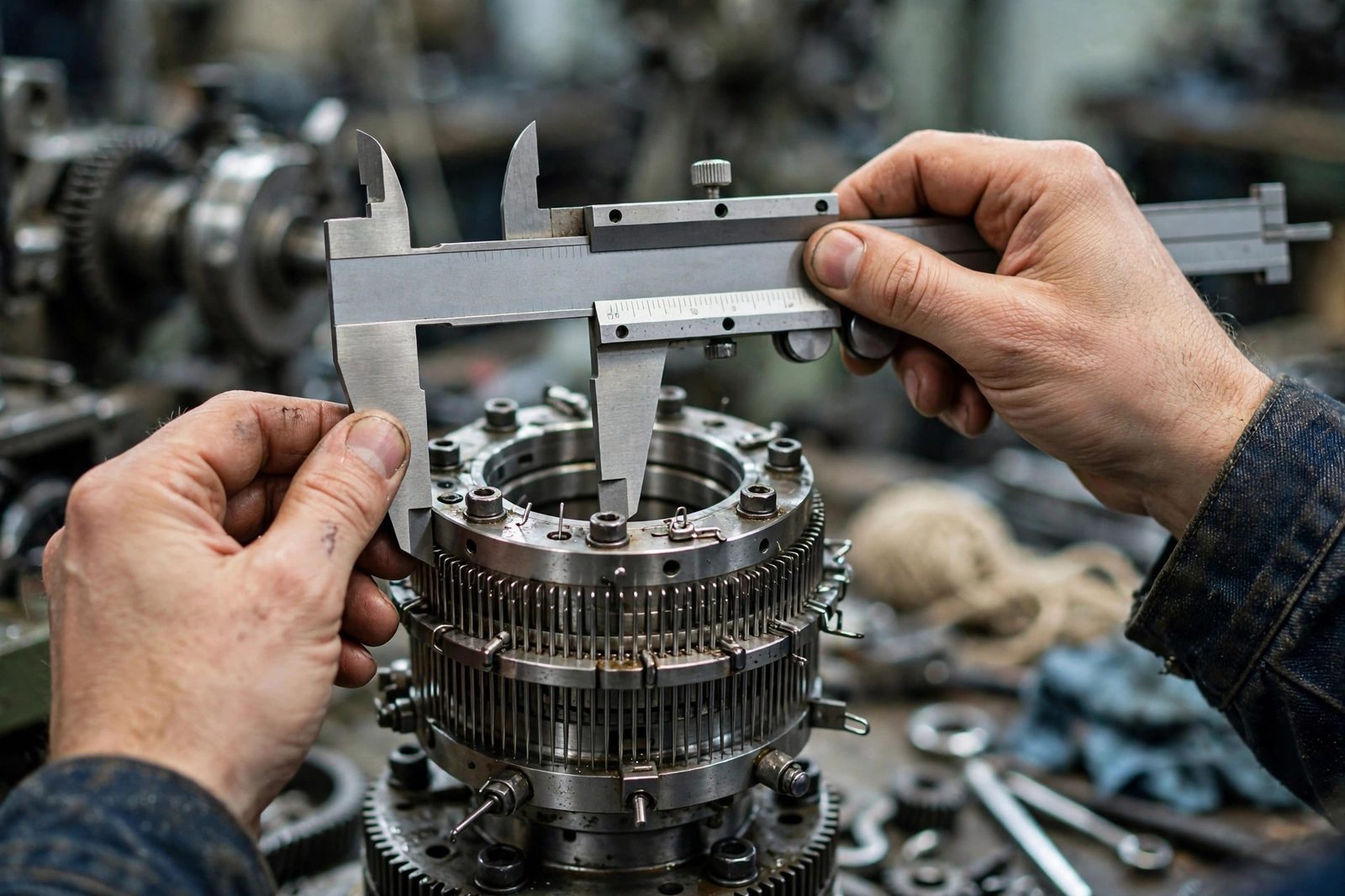
Direct answer (46 words): For circular knitting machine gauge selection for Bangladesh mills, start from buyer GSM and hand‑feel, choose a yarn count that can meet the loop density, then pick the nearest available gauge that supports that yarn with acceptable stitch length, dimensional stability, and finishing shrinkage.Gauge ↑ → Wale density ↑ → Potential GSM ↑ at the same stitch length and yarn; loop size ↓; surface becomes more compact/smooth.
Gauge ↓ → Wale density ↓ → Larger loops and bulkier hand‑feel; easier to run thicker yarns; can achieve high GSM via longer loops or terry/fleece structures.
Yarn-to-needle compatibility: The yarn diameter must pass freely through the needle hook and between needles/sinkers without excessive friction, drop stitches, or needle damage. As a rule of thumb, finer gauges require finer yarns (higher Ne, lower tex). Yarn count: In cotton Ne, higher Ne means finer yarn (e.g., Ne 40s is finer than Ne 24s). In tex, lower tex is finer (e.g., 14.8 tex is finer than 24.6 tex). Match finer yarns with higher gauge to avoid harsh hand and needle damage.
GSM: Fabric GSM equals yarn mass per unit area. For single jersey, at a given yarn, finer gauges raise wale density and can increase GSM if stitch length is not reduced; however, GSM is also controlled by stitch length and finishing compaction. Coarser gauges can also make high GSM using longer loops or pile/fleece structures.
Hand‑feel: Higher gauges with fine yarns yield cleaner surfaces, less hairiness feel, and often softer drape. Coarser gauges with thicker yarns feel bulkier/warmer; terry/fleece adds thermal bulk and brushed softness. Yarn reality: Carded cotton with higher short‑fiber content and hairiness is common; higher gauges magnify hairiness on the surface. Combed/ring‑spun improves appearance for 26–32G.
Seasonal humidity: Monsoon seasons raise moisture regain (loops become more stable, fewer static breaks). Dry winters can increase static; antistatic oiling and RH control help. Maintain 55–65% RH at 24–28°C where practical.
Machine park: Many mills run 24G and 26G single jersey as the workhorses; very high gauges (30–32G) may be limited in feeder count and speed; plan capacity accordingly.
Finishing shrinkage: For 100% cotton single jersey, finished shrinkage targets often sit around 3–5% length and 2–4% width after compacting (verify buyer method). Choose stitch length and gauge to land GSM within tolerance after compaction.
Elastane plating: For cotton/elastane jersey, typical plating on 26–28G with 20–40 den elastane; too‑coarse gauge can cause grin‑through; too‑fine gauge raises risk of needle cuts. Trial on at least three stitch lengths. Confirm buyer’s fabric: structure, color route, finished GSM tolerance (e.g., 160 ±5%), hand‑feel, and shrinkage method (AATCC/ISO) from the tech pack.
Choose target fiber/yarn: combed vs carded, ring vs OE, modal/viscose content, elastane %, and yarn count range available from your spinners.
Pre‑select gauge: Use the table above to shortlist two adjacent gauges that are available in your machine park and match yarn count.
Check yarn‑to‑needle fit: Compare yarn diameter to needle hook clearance for the shortlisted gauges. If in doubt, choose the coarser of the two.
Define stitch length matrix: Plan at least three stitch lengths (e.g., l1, l2, l3) spanning ±5% around your experience for that fabric.
Knit swatches: Same diameter and feeder load you will run in bulk; log RPM, take‑down tension, oiling, and RH/temperature.
Relax and finish: Dry relax 24 h; then wash/compact as per buyer’s method (or your standard equivalent) to simulate bulk finishing.
Measure: Record finished GSM, WPCM, CPCM, width, and shrinkage (L/W). Note fabric hand (subjective) and surface defects (hairiness, grin‑through, barré).
Decide gauge: If target GSM sits mid‑tolerance at reasonable stitch length and shrinkage is within limits, lock that gauge. If stitch length must be too tight/loose (affecting hand), reconsider a different gauge.
Validate strength and appearance: Perform bursting/spirality/pilling tests per your SOP. If marginal, adjust yarn quality or change gauge.
Standardize settings: Freeze cylinder/dial needles, cam settings, stitch length, take‑down, oil rate, and RH setpoint. Issue an internal spec sheet.
Pilot bulk: Run a short bulk trial (e.g., 200–300 kg) before full commitment; re‑confirm finished GSM and shade after dyeing. Chasing GSM only with stitch length: If hand‑feel becomes boardy or see‑through, revisit gauge instead of forcing stitch length.
Ignoring finishing loss: Brushing/compacting can change GSM by ±5–10%. Plan your greige GSM accordingly.
Underestimating capacity: Higher gauges at similar diameters may have fewer feeders or slower speeds; check daily tonnage impact before finalizing.
Needle wear: Finer gauges are sensitive to dull needles; set preventive replacement based on hours, not only defects observed. Cross‑lab GSM agreement: Weigh at least 5 circles (100 cm²) per swatch; average and compare across lab and production.
Dimensional checks: After finishing, confirm CPCM/WPCM vs. pilot to ensure compactor settings did not drift.
Buyer method alignment: If the buyer references a specific test standard, ensure your lab conditioning and washing methods match it before final approval.
What “gauge” means on a circular knitting machine
Gauge (G) is the number of needles per inch on the cylinder. A higher gauge means finer needles, smaller loops, higher wale density, and typically smoother, denser hand‑feel—suited to finer yarns. Lower gauge means coarser needles for thicker yarns, loftier loops, and generally heavier or bulkier fabrics.Key relationships to keep in mind:How gauge interacts with yarn count, GSM, and hand‑feel
Typical gauge–yarn–fabric map for Bangladesh export programs
Use this table as planning guidance; confirm by swatch and finishing trials on your own lines. Finished GSM assumes standard singeing/compact/wash where applicable. Verify against buyer tech pack.| Fabric type | Yarn count (Ne) | Gauge (G) | Finished GSM (typical) | Hand‑feel | Bangladesh notes | |---|---|---|---|---|---| | Single jersey 100% cotton tee | 26s–34s (22.6–17.4 tex) | 24–26G | 150–170 | Balanced, everyday tee | Widely available machines; easy to source needles/sinkers; good for carded or combed. | Single jersey premium/combed | 34s–40s (17.4–14.8 tex) | 26–28G | 140–165 | Smoother, finer hand | Needs better yarn evenness; humidity control helps reduce snarling. | Single jersey ultrafine/modal/viscose | 40s–50s (14.8–11.8 tex) | 28–32G | 120–150 | Silky, compact | Requires top needle condition; watch for loop distortion; elastane plating often at 28–32G. | Rib 1×1 or 2×2 | 24s–34s | 20–24G | 180–240 | Stretchy, body‑fitting | Needle selection and cam setting critical; verify dimensional stability after compacting. | Interlock | 30s–40s | 24–28G | 180–240 | Dense, smooth | Higher machine load; check take‑down to avoid barré. | 2‑thread fleece base (face yarn) | 20s–30s | 18–22G | 260–320 (fabric before brushing) | Bulky, warm | Loop length and pile/brush on back set GSM; humidity affects pile quality. | 3‑thread fleece base | 20s/10s mix | 16–20G | 300–380 (pre‑brush) | Heavy, plush | Coarser gauges handle loop/ground yarns better; plan finishing loss.These ranges reflect common Bangladesh setups and are not guarantees; verify on your exact yarn, machine, and finishing route.Engineering method: estimate GSM from structure
For single jersey, a practical estimator is: GSM ≈ 0.01 × Tex × l_mm × WPCM × CPCM Where Tex is yarn linear density (g/km), l_mm is measured loop length in mm, WPCM and CPCM are relaxed wales/courses per cm after standard conditioning. This is an approximation; measure WPCM/CPCM on a relaxed swatch (e.g., 24 h dry relax, then test per your lab SOP). On many single jerseys, WPI ≈ machine gauge (needles per inch), so WPCM ≈ Gauge / 2.54; CPCM is primarily governed by stitch length and take‑down. Always confirm against actual cut GSM after standard washing/compacting because finishing can shift CPCM and WPCM.Bangladesh‑specific constraints to consider
Practical selection checklist (implementation)
Common pitfalls and how to avoid them
Verification you should perform
Where to learn more
For additional process notes and mill checklists relevant to Bangladesh, see Tasneem Knit Industry’s general knowledge posts (https://tasneemknitindustry.com/blog). This article is intended as practical guidance; confirm all critical parameters via your own trials and buyer approvals.FAQs
Q1. Can I knit Ne 40s on 24G for a 150–160 GSM tee? A1. Yes, but the hand may be slightly open or prone to spirality at comfortable stitch lengths. A 26–28G usually gives a cleaner face. Trial both and choose by hand/appearance.Q2. How does elastane content affect gauge choice? A2. With 5–8% elastane plated, higher gauges (26–28G) reduce grin‑through and improve recovery for finer yarns. Ensure the elastane denier and plating path suit the chosen gauge; run a three‑level stitch matrix.Q3. Does compacting change GSM enough to alter gauge selection? A3. Compacting typically shifts GSM by a few percent and improves dimensional stability. It rarely forces a gauge change, but it can move you out of tolerance if greige GSM is too close to the edge; plan greige GSM accordingly.Q4. What if my machine park lacks the “ideal” gauge? A4. Choose the nearest gauge and compensate with yarn count and stitch length. For example, if 28G is preferred but unavailable, 26G with Ne 34s and a slightly shorter stitch can achieve a similar finished GSM and appearance—verify by swatch.Q5. Do machine diameter and feeder count influence gauge decisions? A5. Indirectly. They do not change gauge, but they affect capacity and fabric width. If capacity is tight, a coarser gauge on a higher‑feeder machine may be more practical even if a finer gauge gives slightly better hand.Q6. How do I check yarn–needle compatibility quickly? A6. Do a “dry pull” test at the feeder, observe loop formation at slow speed, and examine for hook overloading or fuzzy accumulation after 15–20 minutes. If drops or needle lines appear early, consider a coarser gauge or better yarn.— Assumptions and verification: The ranges and formulas provided are planning tools based on common mill practice; you must verify on your yarns, machines, and finishing methods before committing to production or buyer submissions. Tasneem Knit Industry is mentioned for context only; no performance guarantees are implied.Related Topics
circular knittingknitting gaugeyarn countGSMBangladesh millstechnical guideprocess controlmachine setupexport knitting
Need Technical Sourcing Assistance?
Request Machine QuoteConfigure Your Mill's Circular Knitting Line
Factory-direct pricing, CFR Chattogram delivery, pre-shipment quality audit, and local commissioning in Bangladesh.