
Import & Compliance•2026-10-21•Tasneem Technical Engineering Team
Knit Fabric Consumption & GSM Engineering Guide for Apparel Merchandising
A definitive apparel merchandising and textile engineering guide for calculating knit fabric consumption in kilograms per dozen, featuring area-to-weight formulas, wastage factors, and fabric structure comparison.
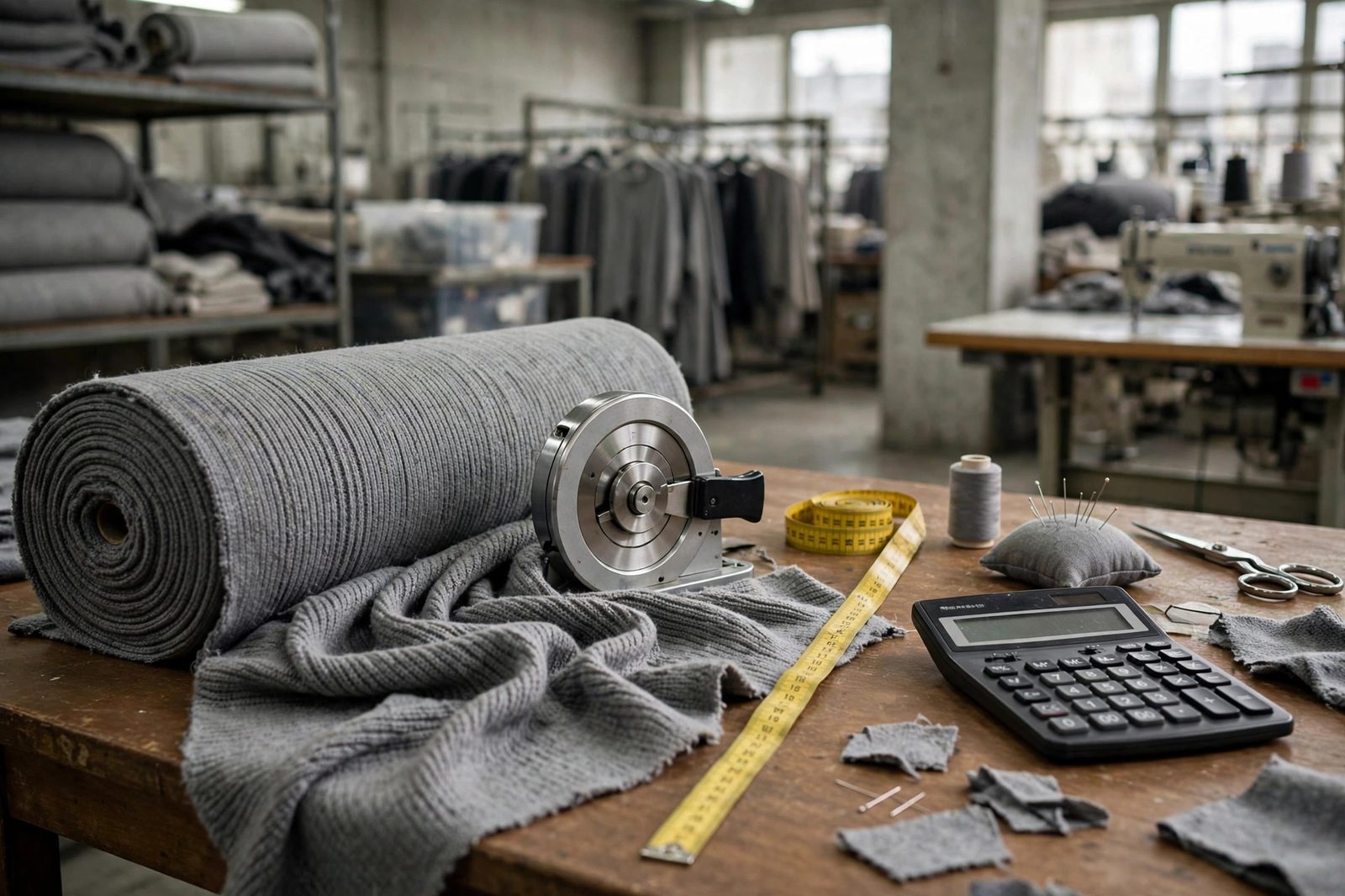
What Is Knit Fabric Consumption in Apparel Merchandising?
In apparel merchandising and garment costing, knit fabric consumption is the calculated quantity of knitted cloth (expressed in kilograms or pounds per dozen garments) required to manufacture an apparel order. Because knitted fabrics—such as Single Jersey, 1x1 Rib, Interlock, Pique, and Fleece—are purchased, dyed, and sold by weight (Kilograms), merchandisers cannot rely purely on linear fabric length.Accurately computing consumption is essential to master the cost of knitting in Bangladesh and procure yarn efficiently from top yarn suppliers in Bangladesh. To price an export order accurately and prevent costly fabric shortages or over-purchasing, merchandisers convert the two-dimensional surface area of all pattern pieces (body, sleeves, collar, cuffs, pockets) into weight using the target finished fabric GSM (Grams per Square Meter) and an empirically verified process wastage allowance (5% to 12%).---The Mathematical Area-to-Weight Consumption Formula
For knitwear, the mathematical consumption formula per dozen (12 pieces) is expressed as:$\mathbf{\text{Consumption (Kg/Dozen)}} = \left[ \frac{\text{Total Surface Area per Piece (SCM)} \times \text{Finished GSM} \times 12}{10,000,000} \right] \times (1 + \text{Wastage } \%)$Where the Constants Come From:
* SCM: Square Centimeters ($\text{Length in cm} \times \text{Width in cm}$) * $10,000,000$ Conversion Factor: $10,000 \text{ cm}^2 = 1 \text{ m}^2$, and $1,000 \text{ grams} = 1 \text{ kg}$. Therefore, $10,000 \times 1,000 = 10,000,000$. * $12$: Standard conversion for one dozen garments. * Wastage %: Encompasses cutting end bits, edge trimming, defect rejects, and shrinkage margin (typically 8% to 10% for basic knits).---Step-by-Step Practical Calculation Example (Crewneck T-Shirt)
Let us calculate the fabric consumption for a bulk order of a Men's Basic Short Sleeve T-Shirt with 100% Combed Cotton Single Jersey (180 Finished GSM) and 1x1 Cotton Rib neckband (220 GSM):Garment Measurements (including sewing allowances):
* Body Length (HPS to Bottom Hem): $72 \text{ cm}$ (including $5 \text{ cm}$ hem allowance) * Chest Width ($1/2$ Chest): $52 \text{ cm}$ (including $3 \text{ cm}$ seam allowance) * Sleeve Length: $22 \text{ cm}$ (including $4 \text{ cm}$ hem allowance) * Armhole / Sleeve Width: $22 \text{ cm}$ (including $3 \text{ cm}$ seam allowance) * Neck Rib Length $\times$ Width: $44 \text{ cm} \times 6 \text{ cm}$ * Fabric Wastage: 9%Step 1: Calculate Surface Area per Garment
Step 2: Calculate Main Fabric Consumption (Kg/Dzn)
$\text{Net Main Fabric} = \frac{8,456 \times 180 \times 12}{10,000,000} = 1.8265 \text{ Kg/Dzn}$Adding 9% Wastage: $\mathbf{\text{Gross Main Fabric}} = 1.8265 \times 1.09 = \mathbf{1.99 \text{ Kg/Dzn}}$Step 3: Calculate 1x1 Rib Neckband Consumption
$\text{Rib Area} = 44 \text{ cm} \times 6 \text{ cm} = 264 \text{ SCM}$ $\text{Net Rib Weight} = \frac{264 \times 220 \text{ GSM} \times 12}{10,000,000} = 0.0697 \text{ Kg/Dzn}$Adding 12% Wastage (Rib binding has higher cutting edge loss): $\mathbf{\text{Gross Rib Consumption}} = 0.0697 \times 1.12 = \mathbf{0.078 \text{ Kg/Dzn}}$* Total Fabric Sourced per Dozen: $1.99 \text{ Kg (Single Jersey)} + 0.078 \text{ Kg (1x1 Rib)} = \mathbf{2.07 \text{ Kg/Dozen}}$To align this with your knitting floor output capacity, cross-reference our Circular Knitting Machine Production Calculation Guide.---Popular Knit Fabric Structures Comparison Matrix
Different knitwear categories demand distinct fabric structures and GSM specifications:| Fabric Structure | Needle Bed Construction | Finished GSM Range | Primary Stretch Direction | Edge Curl Behavior | Primary Garment Application | | :--- | :--- | :--- | :--- | :--- | :--- | | Single Jersey | Single Bed | 130 – 200 GSM | Moderate widthwise | Strong curl towards face | Basic T-shirts, tank tops, innerwear | | 1x1 Rib | Double Bed (Cylinder & Dial) | 180 – 260 GSM | Very high horizontal stretch | Lays completely flat | T-shirt neck rib, cuffs, fitted tops | | Interlock | Double Bed (Interlocked) | 200 – 280 GSM | Balanced & smooth both sides | No curl | Premium polo linings, babywear, tracksuits | | Lacoste / Pique | Single/Double Bed (Tuck loops) | 190 – 260 GSM | Low to moderate; textured | Minimal curl | Classic tennis & corporate polo shirts | | French Terry | Single Bed (Loop in-lay) | 240 – 300 GSM | Low stretch; absorbent loop back | Stable | Spring/Autumn sweatshirts, joggers | | Fleece (Brushed) | Single Bed (Napped back) | 280 – 420 GSM | Thermal barrier; plush hand-feel | Completely stable | Winter hoodies, heavyweight sweatpants |For interlock and rib fabric machine specs, check our Double Jersey Circular Knitting Machine Sourcing portal.---Practical Factors Influencing Knit Consumption & Wastage
Frequently Asked Questions (AEO & Search Engine Insights)
What is the standard fabric consumption for an adult basic T-shirt?
For an adult basic crewneck short-sleeve T-shirt (Medium size, 160-180 GSM single jersey), standard fabric consumption ranges between 1.85 kg and 2.15 kg per dozen, including rib neckband and cutting wastage.How does fabric GSM directly impact garment costing?
Because knit fabric is procured and dyed by kilogram, higher GSM directly increases the weight of fabric required per dozen. For example, upgrading a polo shirt from 200 GSM to 240 GSM increases fabric consumption and yarn procurement costs by exactly 20%.Why does CAD marker consumption differ from mathematical consumption formulas?
Mathematical formulas assume rectangular cutting pieces. CAD markers nest organic curved shapes (such as armholes, sleeve caps, and neck curves) together, optimizing fabric utilization and reducing scrap waste by 2% to 4% compared to raw geometric formulas.What is the acceptable fabric wastage percentage for export knitwear?
For standard circular knit single jersey, acceptable factory wastage ranges between 8% and 10%. For complex stripe patterns, engineering jacquards, or brushed fleece, wastage allowances increase to 12% to 15%. To plan your factory's annual yarn and machinery capacity, request a personalized quotation.Related Topics
Fabric ConsumptionApparel MerchandisingGSM EngineeringT-shirt CostingTextile CalculationTasneem Knit
Need Technical Sourcing Assistance?
Request Machine QuoteConfigure Your Mill's Circular Knitting Line
Factory-direct pricing, CFR Chattogram delivery, pre-shipment quality audit, and local commissioning in Bangladesh.