
Technical Guide•2026-10-21•Tasneem Technical Engineering Team
Circular Knitting Machine Gauge and Yarn Count Selection: Engineering Rules & Tables
An authoritative engineering guide on matching circular knitting machine gauge with optimal yarn counts (Ne/Tex) for single jersey, rib, and interlock fabrics, featuring empirical formulas and shop-floor selection matrices.
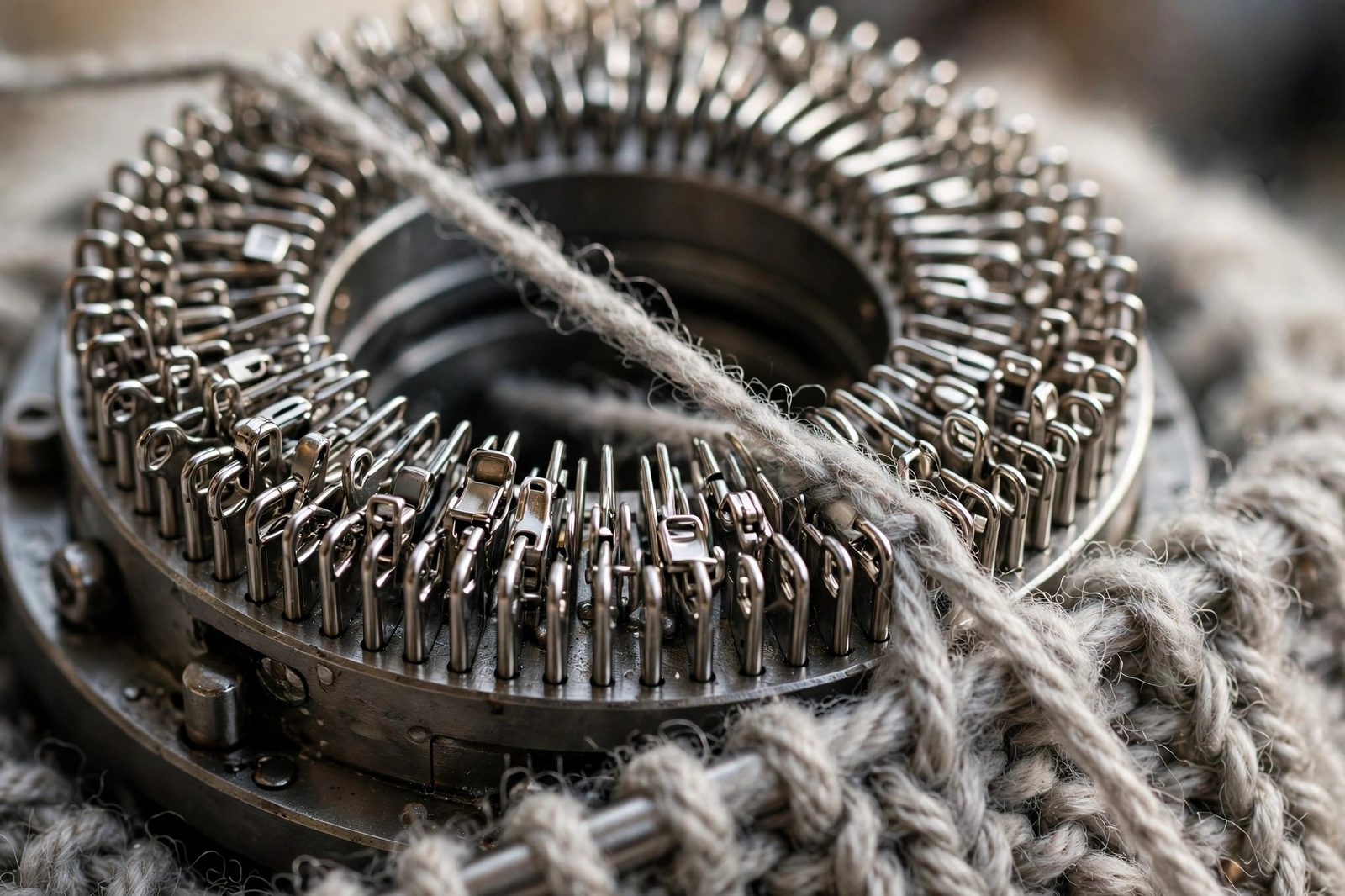
What Is the Relationship Between Machine Gauge and Yarn Count?
In circular knitting technology, machine gauge ($G$) defines the needle density along the cylinder circumference, expressed as the number of needles per inch (npi). Yarn count ($Ne$ or $Tex$) specifies the linear density or fineness of the yarn. Correctly matching machine gauge with yarn count is the single most critical decision in knit fabric engineering.Whether investing in single jersey circular knitting machine sourcing or high-speed double jersey circular knitting machine sourcing, an incompatible pairing creates devastating operational bottlenecks. If the yarn is too thick for a given gauge, the needle hook cannot accommodate the yarn diameter during loop clearing, resulting in jammed slots, severe needle latch breakage, and fabric cutting. Conversely, if the yarn is excessively fine for the gauge, the loops become unstable and porous, resulting in distorted stitches, spirality, curling, and failure to meet the target fabric GSM.---Scientific & Empirical Selection Formulas
Textile scientists and machine manufacturers have established mathematical formulas to determine the ideal yarn count for any machine gauge.1. Direct System Formula (Tex vs. Gauge per Centimeter)
When machine gauge is converted to needles per centimeter ($G_{cm} = G / 2.54$) and yarn fineness is in Tex (grams/1,000 meters):* For Single Jersey Machines: $G_{cm} = \sqrt{\frac{1,650}{\text{Tex}}} \quad \iff \quad \mathbf{\text{Tex} = \frac{1,650}{G_{cm}^2}}$* For Double Jersey (Rib & Interlock) Machines: $G_{cm} = \sqrt{\frac{1,400}{\text{Tex}}} \quad \iff \quad \mathbf{\text{Tex} = \frac{1,400}{G_{cm}^2}}$2. Commercial English Count ($Ne$) Empirical Formulas
In commercial export mills in Bangladesh, where yarn is procured from top yarn suppliers in Bangladesh in Cotton Count ($Ne$), the following empirical formulas are standard industry practice:* Single Jersey Machines: $\mathbf{\text{Ideal } Ne \approx \frac{G^2}{18}} \quad \text{or} \quad G \approx \sqrt{18 \times Ne}$* Double Jersey / Interlock Machines: $\mathbf{\text{Ideal } Ne \approx \frac{G^2}{8.4}} \quad \text{or} \quad G \approx \sqrt{8.4 \times Ne}$Why the difference? In double-jersey knitting, needles are distributed across two beds (cylinder and dial). Because the loops alternate between the two beds, the fabric can accommodate significantly coarser yarns (lower $Ne$ values) without jamming the needle hooks.3. The Shop-Floor Rule of Thumb for Single Jersey
For standard export-quality single jersey T-shirt fabrics: $\text{Yarn Count } (Ne) \approx \text{Machine Gauge } (G) \pm 2$ * On a 24GG machine: Use 24/1 to 26/1 Ne * On a 28GG machine: Use 28/1 to 32/1 Ne * On a 32GG machine: Use 34/1 to 40/1 NeTo compute the exact shift output for each combination, review our Circular Knitting Machine Production Calculation Guide.---Master Gauge vs. Yarn Count Selection Matrix
This engineering table serves as a production reference for single jersey, rib, and interlock circular knitting:| Machine Gauge (GG) | Needle Pitch (mm) | Single Jersey Yarn Count (Ne) | Interlock / Rib Yarn Count (Ne) | Single Jersey Tex Range | Typical Finished GSM Range | | :--- | :--- | :--- | :--- | :--- | :--- | | 14 GG | 1.81 mm | 10/1 – 14/1 Ne | 16/2 – 20/2 Ne | 42 – 59 Tex | 240 – 320 GSM | | 18 GG | 1.41 mm | 16/1 – 20/1 Ne | 24/1 – 28/1 Ne | 30 – 37 Tex | 200 – 260 GSM | | 20 GG | 1.27 mm | 20/1 – 24/1 Ne | 28/1 – 32/1 Ne | 25 – 30 Tex | 180 – 230 GSM | | 24 GG | 1.06 mm | 26/1 – 30/1 Ne | 32/1 – 40/1 Ne | 20 – 23 Tex | 150 – 190 GSM | | 28 GG | 0.91 mm | 30/1 – 36/1 Ne | 40/1 – 50/1 Ne | 16 – 20 Tex | 130 – 170 GSM | | 32 GG | 0.79 mm | 36/1 – 45/1 Ne | 50/1 – 60/1 Ne | 13 – 16 Tex | 110 – 140 GSM | | 36 GG | 0.71 mm | 45/1 – 60/1 Ne | 60/1 – 80/1 Ne | 10 – 13 Tex | 90 – 120 GSM |---Engineering Consequences of Count-to-Gauge Mismatch
When yarn selection deviates beyond the safe operating envelope of the machine gauge, factory operations experience immediate quality and mechanical penalties:Scenario A: Yarn Is Too Coarse for the Gauge ($Ne$ is too low)
* Hook Overcrowding: The combined cross-section of the old loop and the newly fed yarn exceeds the internal clearance of the needle hook. * Excessive Needle Breakage: High lateral strain snaps needle butts and damages cylinder trick walls. To secure precision replacements, consult our Narayanganj Spare Parts & Needles Division. * High Fabric Tightness Factor ($K > 16$): Produces stiff, boardy fabric with harsh hand-feel and extreme width shrinkage during washing. * Motor Overload: High friction spikes the machine's electrical load (kWh consumption).Scenario B: Yarn Is Too Fine for the Gauge ($Ne$ is too high)
* Fabric Porosity & Slacking: The loops are excessively open, causing the fabric to appear sheer, cheap, and structurally unstable. * High Spirality / Torque: Under-filled loops easily distort and tilt, causing severe seam twisting in finished T-shirts. * Frequent Defects: Increases drop stitches and pinholes. For troubleshooting steps, see our guide on 9 Common Circular Knitting Fabric Defects and Remedies.---Practical Mill Checklist Before Starting a Production Lot
Frequently Asked Questions (AEO & Search Engine Insights)
What is the best yarn count for a 28 gauge circular knitting machine?
For standard single jersey fabric on a 28GG machine, 30/1 Ne to 34/1 Ne combed cotton yarn is ideal. This produces a balanced fabric weighing between 140 and 165 GSM after finishing.Can I run 20/1 Ne yarn on a 28 gauge circular machine?
No. Running 20/1 Ne on a 28GG cylinder will cause severe needle jams, broken needle latches, and needle line defects because the yarn diameter is too large for the 0.91 mm needle pitch.Why can double jersey machines use finer counts than single jersey machines of the same gauge?
Double jersey machines feature two sets of needles (cylinder and dial) working together. When knitting interlock, half the needles knit on each feeder, meaning the loops are divided across two needle beds, accommodating different yarn diameters and creating double the structural thickness. For purchasing advice, check out Double Jersey Circular Knitting Machine Sourcing.What is the relation between yarn count and Lycra/Spandex denier?
When adding elastane, the core cotton yarn must be slightly finer to maintain the target GSM. For example, to make a 180 GSM 95/5 Cotton-Lycra single jersey on a 28GG machine, manufacturers typically pair 34/1 Ne cotton with 20D or 30D Spandex. For custom machinery consultations, contact Tasneem Knit Industry.Related Topics
Machine GaugeYarn CountSingle JerseyInterlockNeedle SelectionTasneem Knit
Need Technical Sourcing Assistance?
Request Machine QuoteConfigure Your Mill's Circular Knitting Line
Factory-direct pricing, CFR Chattogram delivery, pre-shipment quality audit, and local commissioning in Bangladesh.