
Sourcing Guide•2026-10-23•Tasneem Editorial Desk
Textile Machinery Supplier Due Diligence Checklist for Bangladesh Buyers
Before signing a textile machinery purchase order, run the supplier through this evidence-based checklist — technical fit, reference mills, inspection protocol, warranty terms, spare-parts supply and commissioning support — to protect your investment.
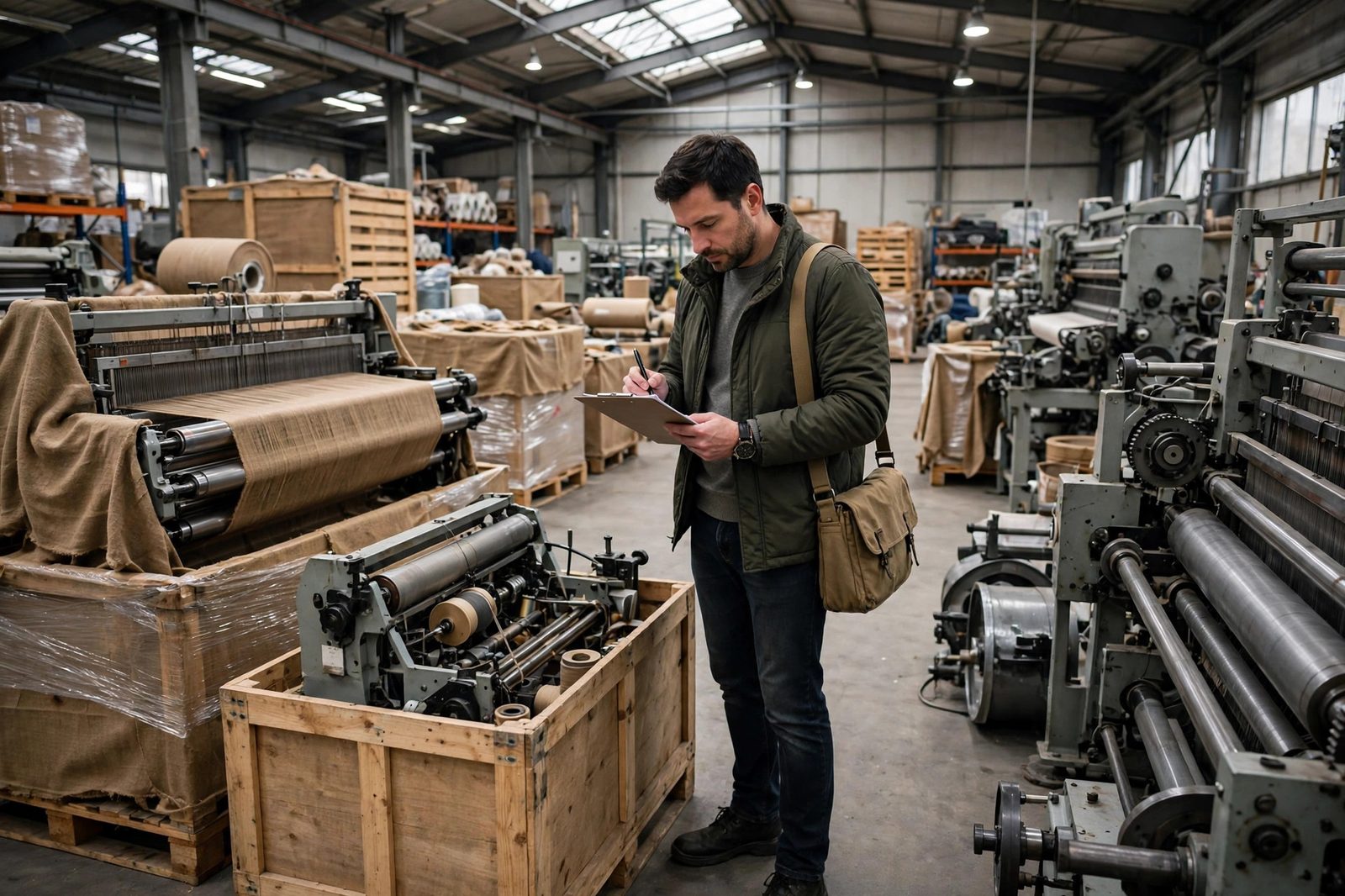
Textile Machinery Supplier Due Diligence Checklist for Bangladesh Buyers
Direct answer: A textile machinery supplier due diligence checklist for Bangladesh buyers is a structured, evidence-based review of technical fit, reference installations, factory inspection, warranty terms, spare-parts supply, commissioning support and commercial documentation — completed before signing the purchase order. It converts supplier promises into verifiable facts, protecting mills from downtime, quality claims and stranded investments.Why due diligence matters for machinery buyers in Bangladesh
Bangladesh is one of the world's largest buyers of circular knitting machinery. In the ITMF's 2022 International Textile Machinery Shipment Statistics, global shipments of large circular knitting machines fell 27% to 28,651 units; Asia and Oceania absorbed 77% of them, and Bangladesh ranked third worldwide with 2,644 units — behind only China and India (source: ITMF 2022 statistics, via textiletechnology.net). A decade earlier the pattern was the same: in 2016 Bangladesh was the third-largest investor with 2,200 units out of roughly 26,200 global shipments (ITMF, via knittingindustry.com). When a country buys machinery at this scale, the difference between a verified supplier and a persuasive brochure is measured in years of mill productivity.A textile machinery supplier due diligence checklist is therefore not bureaucracy — it is how a mill in Gazipur or Narayanganj turns a supplier's claims into testable commitments before money moves.Step 1: Prove technical fit with a written User Requirement Specification
Start with your own document, not the supplier's catalogue. A User Requirement Specification (URS) states the fabric program, yarn count range, target GSM band, gauge, cylinder diameter, speed (RPM) target, defect tolerance and the buyer quality standards the machine must meet.Demand a clause-by-clause response to the URS with every deviation highlighted in writing — this is standard RFQ practice recommended in textile buying guides, and it exposes the gap between "our machine can do it" and documented capability. If the fabric program includes rib or interlock on specific diameters, cross-check the cylinder diameter selection guide before accepting the supplier's configuration.Evidence to collect: signed URS response, stitch-length and GSM capability tables for your yarn counts, motor and drive specifications.Step 2: Verify reference installations, not brochures
A supplier evaluation checklist used across the industry (globaltradegrid's machinery evaluation framework) puts reference installations in similar product categories first: has this exact model run for at least a year in a mill producing your fabric type, at your quality level? Ask for:Step 3: Inspect before you pay — FAT, SAT and pre-shipment checks
Agree the acceptance protocol in the contract: a Factory Acceptance Test (FAT) at the maker's works and a Site Acceptance Test (SAT) after erection, each with a minimum operating duration, allowable defect criteria, measurement methods and the test report format. Laboratory-style demonstrations are not production proof; the protocol must state the machine configuration, approved software version and the records to be delivered — a discipline emphasized in supplier-verification guides for textile machinery sourcing.For shipments from overseas makers, layer a formal pre-shipment inspection checklist over the FAT: specifications, documents, packaging, test-run evidence and acceptance sign-off before the balance payment is released.Evidence to collect: signed FAT report, SAT protocol with remedies for missed performance, packing and loading photos.Step 4: Read the warranty terms line by line
Twelve months of full coverage is the prevailing industry norm for circular knitting machines: a 2025 survey of Chinese makers (sourcifychina) lists one-year warranties across Sintelli, Shijia, Chiyang and ZLH, and procurement guidance (accio) recommends a minimum 12-month full coverage, with typical exclusions for wear parts such as needles, brushes and rollers. Translate the norm into contract language:Step 5: Secure the spare-parts future
A machine is only as reliable as its parts pipeline. Require a recommended two-year operating-spares list with itemized prices and critical-spares lead times, and confirm parts availability for at least five years after purchase — the benchmark procurement guidance cites for knitting machinery. Prefer suppliers holding local stock covering 6–12 months of consumables for your fleet, and confirm that component substitutions need your written approval, since unapproved "equivalent" parts can void warranty responsibility.Tie the spares list to your preventive maintenance schedule so the first year's consumption is already planned.Evidence to collect: priced spares list, lead-time commitments, local stock confirmation, substitution-approval procedure.Step 6: Commissioning, training and handover
Machines fail most often in the first month — during installation and ramp-up. The contract needs a responsibility matrix: who erects, who levels, who sets parameters, who trains operators and who signs off. Insist on bilingual operating manuals, parameter recipe sheets for your fabric program, a wear-parts list and structured operator training covering start/stop discipline, defect recognition and abnormality handling. A supplier with application engineers can cut line-stabilization time from several days to one or two shifts — verify that capability exists, not just on paper.Evidence to collect: commissioning schedule, training plan with trainee sign-off sheets, complete documentation set at handover.Step 7: Lock the commercial and documentation terms
Commercial clarity is part of due diligence: itemized price with every exclusion listed, payment milestones tied to FAT/acceptance (not just shipment), delivery terms, penalties for missed performance and change-order rules. For Bangladesh imports this sits on top of the L/C documentation chain — map it with the L/C documents guide so the commercial terms and the banking documents agree with each other.Evidence to collect: itemized quotation, milestone-linked payment schedule, delivery terms, penalty and change-order clauses.Turn the checklist into a decision: a simple scorecard
Score each shortlisted supplier 0–5 on seven dimensions, weighted by your risk: technical fit (25), reference installations (15), inspection and acceptance protocol (15), warranty terms (15), spare parts and after-sales (15), commissioning and training (10), commercial clarity (5). The supplier with the highest weighted score — not the lowest price — is the one whose promises survived verification. Keep the scorecards; they are your audit trail if performance disputes arise later.FAQs
Q1: What is the single most important due-diligence document for a textile machinery purchase? The signed Factory and Site Acceptance Test protocol with measurable criteria — operating duration, defect limits, output and the remedies if targets are missed. Everything else (brochures, references, warranties) supports this document; nothing replaces it.Q2: Is a 12-month warranty enough for a circular knitting machine? Twelve months full coverage from commissioning is the industry norm, with wear parts excluded. Negotiate longer coverage for the control system and electronics — the most expensive failures — and get the response-time commitments in writing rather than as verbal promises.Q3: Can I trust a trading company as much as a factory-direct supplier? Yes, if it passes the same checklist: its own engineering team, local spare-parts stock, named reference mills, and a warranty it signs in its own name. A trading company that only forwards the maker's promises adds risk; one with engineers and stock adds value.Q4: How do I verify a supplier's export experience? Ask for export shipment records or reference mills in export markets, CE and ISO 9001 certificates issued to the maker (not a sister company), and the export compliance documentation they will supply with your shipment — commercial invoice, packing list, test certificates and manuals.Q5: Should due diligence differ for a second-hand machine? The checklist gets stricter, not looser: add frame and cylinder wear measurement, cam-track inspection, electronics age, a supervised test run on your yarn, and documented service history. Warranty on used machines is typically shorter and heavily exclusion-based — price that into the decision.Related Topics
supplier due diligencetextile machinery Bangladeshmachine sourcing checklistwarranty termsspare parts supplyসরবরাহকারী যাচাইকরণটেক্সটাইল মেশিনারিকমিশনিং সহায়তা
Need Technical Sourcing Assistance?
Request Machine QuoteConfigure Your Mill's Circular Knitting Line
Factory-direct pricing, CFR Chattogram delivery, pre-shipment quality audit, and local commissioning in Bangladesh.