
Technical Guide•2026-10-31•Tasneem Editorial Desk
Circular Knitting Machine Cam System Types and Selection for Bangladesh Mills
Knit, tuck and miss cam tracks decide what every needle does at every feeder. This guide explains cam types, single jersey, rib and interlock arrangements, and how stitch-cam depth controls GSM for Bangladesh export mills.
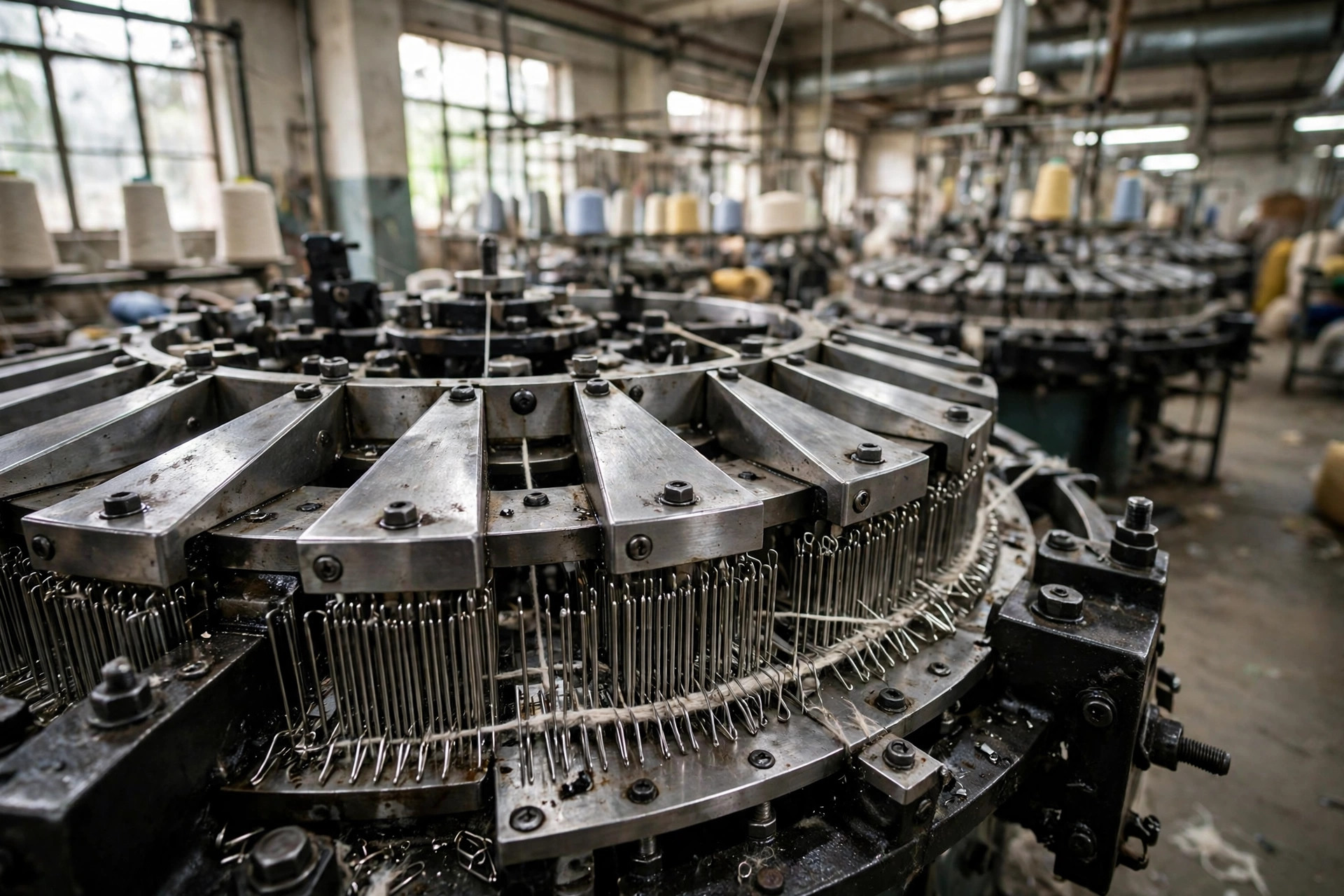
Direct answer: A cam system is the set of stationary tracks that guides each needle through clearing, yarn feeding and knock-over at every feeder. Knit, tuck and miss tracks decide whether a needle forms a loop, holds yarn without looping, or skips the yarn. The right cam arrangement for single jersey, rib or interlock, plus correct stitch-cam depth, controls stitch length, GSM and fabric quality.Knit position: The needle rises fully to clear the old loop, takes the new yarn, and is drawn down through the old loop to form a new stitch. This is the normal loop-forming action.
Tuck position: The needle rises only part-way. It takes the new yarn but does not clear the old loop, so the yarn is held as a tuck loop without forming a complete new stitch. Tuck stitches add thickness, texture and width, and they are used in structures such as piqué, fleece backing and honeycomb effects.
Miss (welt) position: The needle stays low and does not take the yarn at that feeder. The yarn floats behind the needle, which is how floats, inlay effects and pattern areas are created, and how one needle group can sit out a feeder on an interlock machine. Every patterned or structured knit fabric is, at bottom, a planned sequence of these three positions across feeders. When a fabric shows an unexpected stripe, hole or thick band, the first check is usually whether needles are reaching the intended position at the right feeder.Single jersey: Only cylinder needles knit, normally with one cam track per feeder. The selection checklist in our circular knitting machine gauge selection guide helps match gauge and yarn count to the fabric before cam settings are touched.
Rib: Cylinder and dial needles knit alternately, so cylinder and dial cam systems must be timed together. The dial-to-cylinder gap and the timing of dial knock-over against cylinder draw-down decide rib appearance and width stability. Our guide on how to choose knitting machine cylinder diameter explains how diameter and finished width interact with these settings.
Interlock: Two feeders work as a pair to make one course. One cam system knits half the needles at the first feeder while the other half misses, and the second feeder reverses the selection. That is why interlock machines need two cam systems per needle bed and why a single mis-timed cam shows up as a half-course defect. A practical rule follows from this: never copy a cam arrangement from one structure to another. A single-jersey cam set run on a rib programme, or an interlock timing applied to a single-jersey order, will produce faults that look like yarn problems but are really timing problems.Fabric programme first: List every structure the machine must run — plain jersey, piqué, fleece, rib, interlock — and confirm the cam set covers all three needle positions for each.
Feeder count and cam tracks: More feeders raise output, as explained in our production capacity calculation guide, but each feeder needs its own correctly timed cam track.
Stitch-cam range: Check that the stitch cam adjusts finely enough for the lightest and heaviest GSM in the order book.
Spare cam and needle compatibility: Confirm that spare cams, needles and sinkers match the machine's gauge and butt dimensions, and keep them in the risk-based plan described in our spare parts inventory guide.
Dial availability: For rib and interlock work, confirm dial cams, dial needles and timing tools are included, not assumed.
Trial before bulk: Run a trial course sequence, check loop formation at every feeder, and record the stitch-cam settings that produced the approved sample.
What Is a Circular Knitting Machine Cam System?
A circular knitting machine cam system is a set of stationary, profiled steel tracks arranged around the cylinder and, on double-jersey machines, the dial. As the cylinder rotates, the butt of each needle rides in a cam track, and the track profile lifts, holds or draws the needle down at exactly the right point in the knitting cycle. The cams do not move the yarn; they move the needles, and the needles move the yarn into loops.A useful definition to keep on the knitting floor is this: the cam system is the machine's timing map. Change the map, and you change the fabric — even with the same yarn, gauge and machine speed. That is why two machines with identical cylinders can produce visibly different fabrics if their cam arrangements differ.The Three Needle Positions: Knit, Tuck and Miss
At each feeder, a needle can take one of three positions, and the cam track selected for that feeder decides which one:Cam Types in a Knitting System
A complete cam system is made of several cooperating cam elements, each with one job:| Cam element | Job | |---|---| | Raising / clearing cam | Lifts the needle so the old loop slides below the open latch and clears the hook | | Stitch cam | Draws the needle down to a controlled depth, setting stitch length | | Guard / auxiliary cam | Keeps the needle butt safely in its track between active sections | | Knock-over cam | Completes the draw-down so the old loop casts off over the new yarn | | Sinker cam | Moves sinkers to hold the fabric down while needles rise and to support knock-over | | Dial cam (double jersey) | Controls the horizontal dial needles in rib and interlock structures |The stitch cam deserves special attention because it is vertically adjustable. Raising it makes a shorter stitch; lowering it makes a longer stitch. Because stitch length directly affects fabric weight, a small stitch-cam adjustment is one of the fastest ways to move GSM — but it must be done evenly across all feeders, or the fabric will show feeder-to-feeder GSM variation.Single Jersey, Rib and Interlock Cam Arrangements
The same cam principles produce very different fabrics depending on how cylinder and dial cams are combined:How Stitch-Cam Depth Controls GSM
GSM (grams per square metre) is the buyer's most-checked fabric property, and cam setting is one of its direct controls. Longer stitch length means more yarn per loop and a heavier, more open fabric; shorter stitch length means less yarn per loop and a lighter, tighter fabric. The relationship is not the only GSM control — yarn count and gauge matter too — but it is the control the knitting floor can adjust without changing yarn.A disciplined way to use it is: change stitch-cam depth in small, equal steps on every feeder; knit a test length; relax and condition the sample; then measure GSM. For comparable results, fabric should be conditioned and tested under a recognised standard atmosphere. ISO 139:2005 defines the standard atmosphere for conditioning and testing textiles as 20.0 °C and 65% relative humidity, with tolerances of ±2 °C and ±4% relative humidity. Measuring GSM on a hot, damp roll straight off the machine and comparing it with a conditioned buyer sample is a common source of false disputes.Selection Checklist for Bangladesh Mills
Before ordering or converting a cam system, work through this checklist:Maintenance, Wear and Troubleshooting
Cams wear slowly, then fail suddenly. A worn cam track lets the needle butt chatter, which breaks needles, marks fabric and eventually cracks the track. Watch for these warning signs: a rising needle-breakage rate at one feeder, a repeating mark at the same course position, unusual noise at one cam box, or GSM drifting on one feeder while others stay stable.Good practice is simple: keep cam tracks clean and lightly lubricated as the machine maker directs, inspect tracks during the scheduled stops in our preventive maintenance schedule, replace a worn cam rather than grinding it by hand, and always check needle and sinker condition after a cam change — a damaged cam damages needles, and damaged needles then damage the new cam. If yarn tension problems appear at the same time as a cam fault, work through our yarn tension troubleshooting guide feeder by feeder instead of changing tension globally.FAQs
What is the difference between a knit cam and a tuck cam?
A knit cam track lifts the needle fully so it clears the old loop and forms a new stitch. A tuck cam track lifts it only part-way, so it takes yarn without clearing, holding the yarn as a tuck loop. The difference is needle height at the feeder, and it is set by which cam track the needle butt follows.Why does interlock need two feeders for one course?
Interlock is made by two needle groups knitting alternately. The first feeder knits one group while the other misses, and the second feeder reverses the groups. Together the two feeders complete one balanced interlock course, which is why both cam systems must be timed as a pair.Can stitch-cam depth alone fix a GSM problem?
It can move GSM within a range, but it cannot fix the wrong yarn count, gauge or fabric structure. If a large GSM correction is needed, check yarn count and gauge first, then use stitch-cam depth for fine adjustment, measured on conditioned samples under ISO 139:2005 conditions.How often should cam tracks be inspected?
Inspect cam tracks at every planned maintenance stop and whenever needle breakage, a repeating fabric mark or feeder-wise GSM drift appears. Early wear shows as polishing or a step in the track; replacing the cam at that stage is far cheaper than the needle breakage and fabric claims a failed cam causes.Related Topics
circular knitting machinecam systemknit tuck misssingle jerseyinterlockক্যাম সিস্টেমসার্কুলার নিটিং
Need Technical Sourcing Assistance?
Request Machine QuoteConfigure Your Mill's Circular Knitting Line
Factory-direct pricing, CFR Chattogram delivery, pre-shipment quality audit, and local commissioning in Bangladesh.