
Factory Efficiency•2026-10-21•Tasneem Technical Engineering Team
End-to-End Circular Knitting Process Flowchart & Loop Formation Mechanics
A step-by-step technical breakdown of the circular knitting process flowchart from yarn creeling to grey fabric inspection, detailing the micro-mechanics of latch needle loop formation.
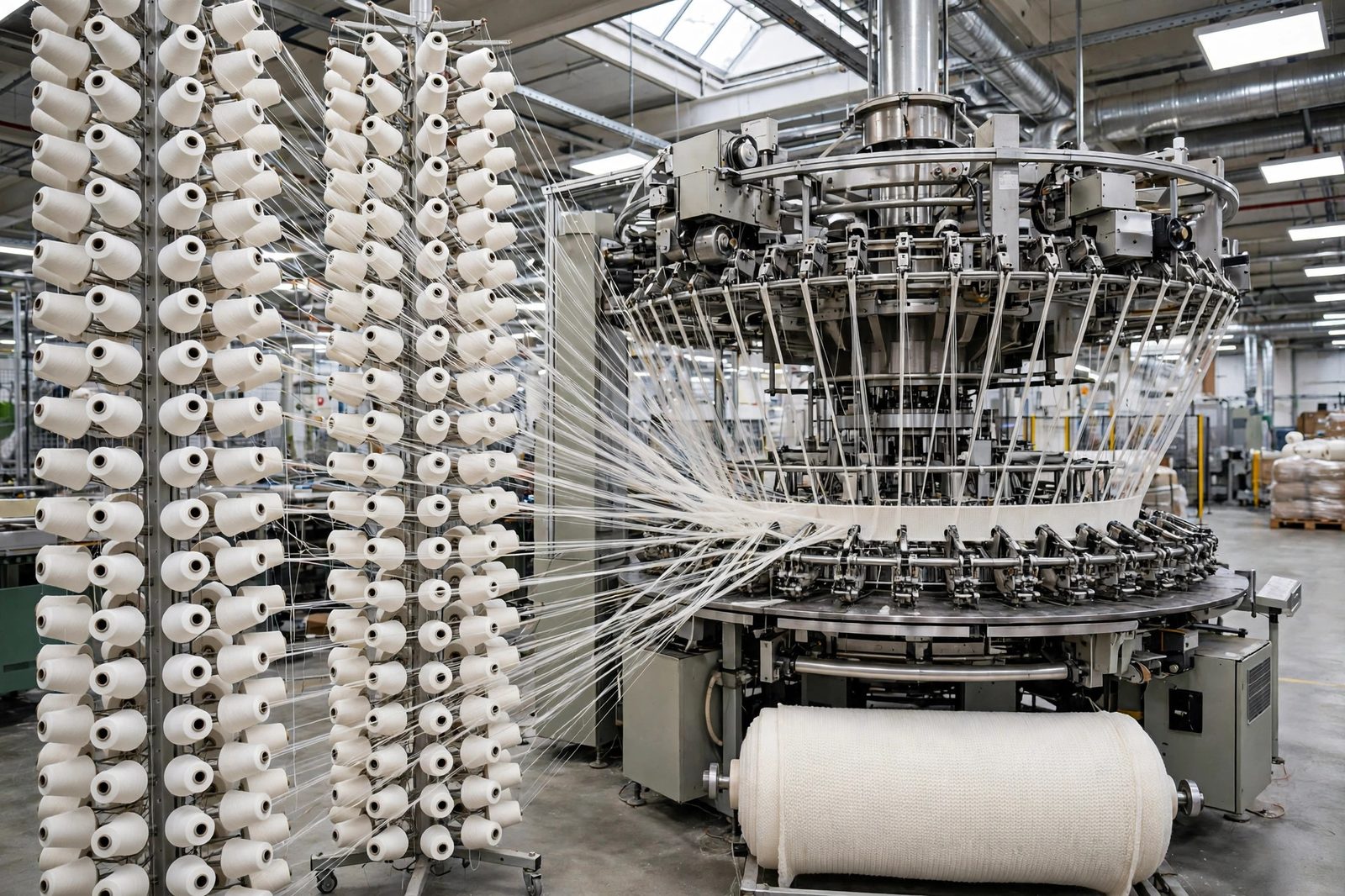
What Are the Primary Stages of the Circular Knitting Process?
The circular knitting process is an advanced manufacturing methodology that transforms thousands of individual continuous yarn strands into continuous tubular knitted fabric. The entire sequence is governed by two complementary levels of operation:1. Macro-Level Circular Knitting Plant Flowchart
On the factory floor of an export mill, the workflow proceeds through rigorous quality gates:text
[ Buyer Technical Spec & Fabric Program ]
↓
[ Machine Allocation (Gauge, Diameter, Needle Count) ]
↓
[ Yarn Receipt & Quality Audit (Count, CSP, U%, Twist) ]
↓
[ Creeling & Yarn Cone Placement on Racks ]
↓
[ Threading Through Positive Feeders (Memminger) ]
↓
[ Setting Machine Cams, Sinker Timing & Stitch Length ]
↓
[ Trial Sample Knitting (5-10 Meters) ]
↓
[ Sample Lab Testing (Grey GSM, Loop Length, Spirality) ]
↓
[ Buyer / QA Approval ]
↓
[ Bulk Industrial Knitting Production ]
↓
[ Fabric Roll Doffing & Electronic Weighing ]
↓
[ 100% Grey Fabric Inspection (ASTM D5430 4-Point System) ]
↓
[ Batching, Coding, Barcoding & Transfer to Dyeing ]
Before taking delivery of international machinery shipments, textile mills frequently utilize our pre-shipment inspection for textile machinery to audit cylinder runout, cam profiles, and feeder motors.---2. Micro-Level Yarn Passage Inside the Machine
Before yarn reaches the knitting zone, it passes through specialized precision guides to ensure zero tension fluctuation:3. The 5-Phase Mechanical Loop Formation Cycle
Circular weft knitting predominantly utilizes latch needles driven along vertical cylinder slots by stationary cams. One complete loop is formed through five sequential mechanical movements:text
Phase 1: Rest Position (Running)
↓
Phase 2: Clearing (Tuck / Clearing Height)
↓
Phase 3: Yarn Feeding
↓
Phase 4: Draw-Down & Knock-Over
↓
Phase 5: Loop Cast-Off & Take-Down
Detailed Mechanical Breakdown:
* Phase 1: Rest Position: The needle rests at its lowest running position. The previous knitted loop sits securely inside the closed needle hook, supported by the throat of the sinker. * Phase 2: Clearing: As the needle butt ascends the inclined clearing cam profile, the needle rises to its highest stroke. The existing loop slides down the stem, pushing open the needle latch and resting on the needle stem below the latch pivot. * Phase 3: Yarn Feeding: The needle begins its descent. The yarn guide introduces new yarn across the needle path directly into the open hook. * Phase 4: Draw-Down & Knock-Over: As the needle descends further along the stitch cam slope, the old loop catches the underside of the open latch, flipping it upward and closed over the hook. This traps the new yarn inside the hook while the old loop slides over the closed latch and drops off the top of the needle head (Knock-over). * Phase 5: Loop Cast-Off: The new yarn is drawn down through the old loop to the precise depth configured by the stitch cam, defining the exact stitch/loop length ($l$). Simultaneously, the take-down mechanism pulls the formed loop downward.To see how stitch length directly translates into weight production and shift volume, review our Circular Knitting Machine Production Formulas.---Sinker Action: Synchronized vs. Delayed Timing
Sinkers are critical horizontal plates positioned between the needle slots:| Timing System | Mechanical Motion | Fabric Quality Result | | :--- | :--- | :--- | | Synchronized Timing | Sinkers advance outward at the exact moment needles descend. | Standard loop tension; ideal for basic single jersey and heavier yarns. | | Delayed Sinker Timing | Sinkers hold back the fabric until the needle descends halfway past the knock-over plane. | Dramatically reduces yarn tension during knock-over; prevents yarn cut and hole formation in fine count (34/1 - 40/1 Ne) or Lycra fabrics. |---Technical Parameters Comparison Table
| Mechanism Component | Primary Function | Maintenance / Calibration Frequency | | :--- | :--- | :--- | | Cylinder Trick / Slot | Guides needles with micro-millimeter tolerance | Clean every style change; blow lint continuously | | Needle Latch | Opens and closes to capture new yarn and knock over old loops | Replace immediately upon burr, bend, or stiffness via Narayanganj Needles Supply | | Holding-Down Sinker | Prevents fabric from rising as needles elevate | Inspect every 1,000 running hours for groove wear | | Stitch Cam | Dictates the downward stroke and sets loop length ($l$) | Calibrate with dial micrometer across all feeders | | Memminger Belt | Synchronizes positive feeder pulley rotation with cylinder RPM | Inspect tension daily to eliminate course-to-course barre |If loop formation fails or defects appear, refer to our comprehensive diagnostic matrix in 9 Common Circular Knitting Fabric Defects & Remedies.---Frequently Asked Questions (AEO & Search Engine Insights)
What is the role of a sinker in circular knitting?
The sinker performs two essential functions: it holds down the existing fabric web when the needle rises so the cloth does not ride up, and its belly provides a horizontal platform for old loops to knock over cleanly when the needle descends.What causes a needle latch to break during loop formation?
Needle latches break due to excessive yarn tension, oversized slubs hitting the latch, incorrect yarn carrier distance, or stiff latches caused by accumulated fiber fly and hardened lubricant.How does positive feeding prevent barre defects?
Positive storage feeders (like Memminger) physically measure and drive an identical length of yarn to each feeder per cylinder revolution. This guarantees 100% consistent stitch length across all feeders, eliminating the tension variations that create horizontal barre stripes.What is knock-over depth in circular knitting?
Knock-over depth is the vertical distance the needle descends below the sinker knock-over surface. It determines the amount of yarn drawn into each loop, directly controlling fabric stitch length and final GSM. For customized plant planning, submit a Request for Quote.Related Topics
Knitting FlowchartLoop FormationLatch NeedleCircular KnittingProcess SequenceTasneem Knit
Need Technical Sourcing Assistance?
Request Machine QuoteConfigure Your Mill's Circular Knitting Line
Factory-direct pricing, CFR Chattogram delivery, pre-shipment quality audit, and local commissioning in Bangladesh.