
Maintenance & Parts•2026-10-18•Tasneem Editorial Desk
How to Reduce Fabric Defects in Circular Knitting: Barre, Needle Lines, Drop Stitches and Oil Marks
Practical guide to reducing barre, needle lines, drop stitches, oil marks and Lycra breakage in circular knitting — causes, measurement-based fixes and a shift-level QC routine for Bangladesh mills.
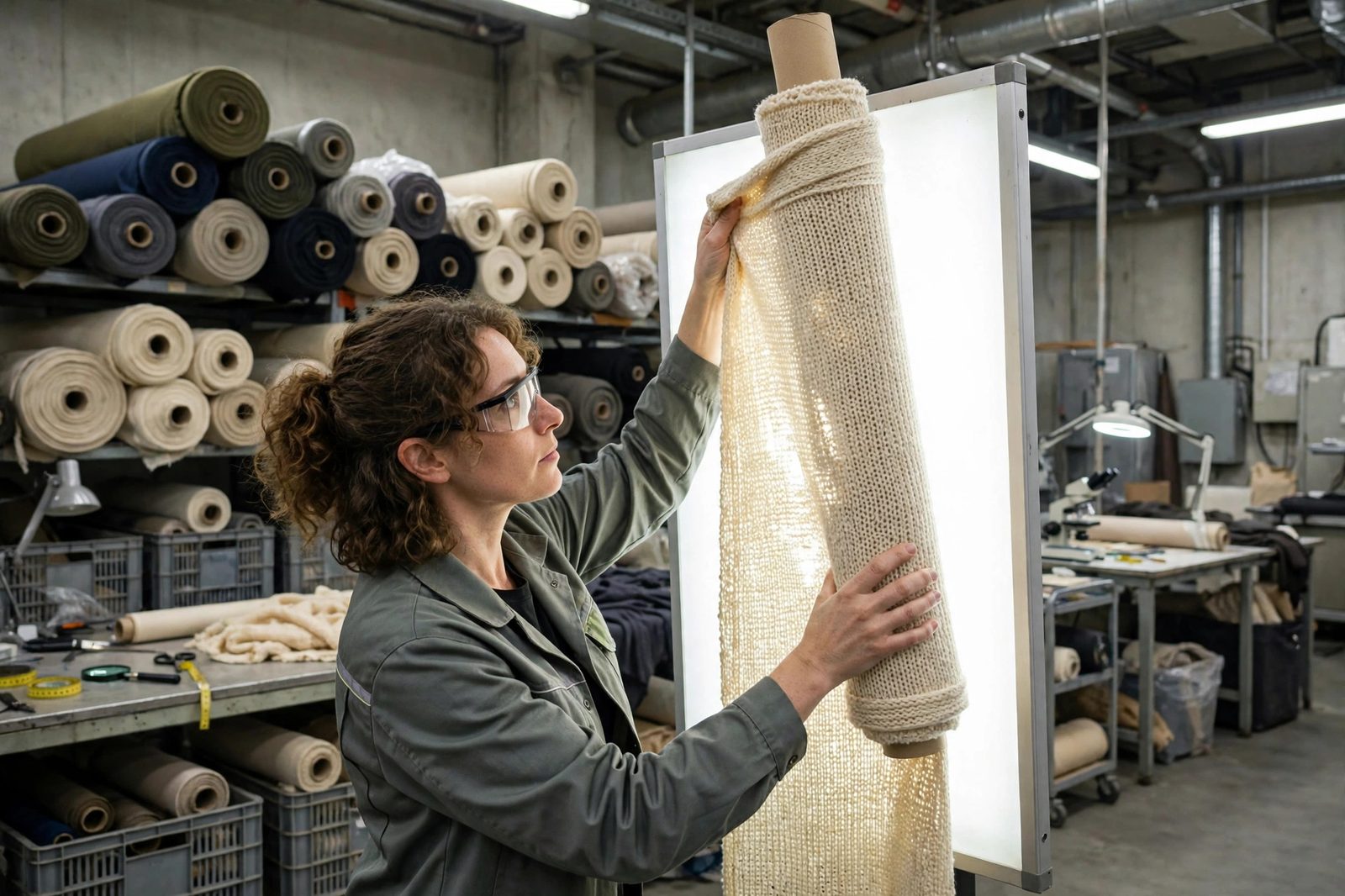
How to Reduce Fabric Defects in Circular Knitting
Direct answer: Fabric defects in circular knitting — barre, needle lines, drop stitches, oil marks and Lycra breakage — almost always trace back to three sources: inconsistent yarn (count, lot or tension), worn or mis-set knitting elements, and poor housekeeping. A mill that standardises feeder tension with a tension meter, runs one yarn lot per order, and follows a documented needle-inspection routine can cut defect-related rework sharply without buying a new machine.Why defects are the mill's most expensive waste
A published study in the International Journal of Textile Science (2016) measured fault rates in a 500-metre roll of single jersey and found drop stitches at 4%, barriness at 3%, streakiness at 3%, needle lines at 3% and oil lines at 3% — and showed that targeted remedies brought each category down to roughly 1–2%. That gap is money: every metre of second-quality fabric sold at a discount, and every roll rejected at the cutting table, inflates the mill's effective wastage. Bangladesh's commerce ministry recently revised the allowable wastage rate to 27% for basic knit items and 30% for special items, yet BKMEA has argued even those revised rates understate the real losses factories face (textileexcellence.com). Reducing defects at the knitting stage is the cheapest way to hold wastage below whatever threshold applies.The five defect families every circular knitting mill should master are barre, needle lines, drop stitches, oil marks and Lycra (spandex) breakage. Each has a distinct visual signature, distinct causes and — crucially — distinct measurement points.Barre and streakiness: the yarn-first defect
Definition: Barre is a horizontal banding defect — periodic lateral irregularities of uniform or variable width that repeat across the fabric — most often a yarn problem, not a machine problem.Main causesNeedle lines and sinker marks: the knitting-element defect
Definition: A needle line is a continuous lengthwise stripe caused by one or more damaged, bent or worn needles; a sinker line is its narrower equivalent from worn or mis-set sinkers.Main causesDrop stitches and holes
Definition: Drop stitches are loops that fail to form — leaving pin holes or open holes in the fabric — caused by loop-formation failure at the needle hook.Main causesOil marks and grease stains
Definition: Oil lines are lengthwise or spot discolouration from excess or migrated lubricating oil reaching the fabric; grease stains are heavier deposits from over-greasing of mechanical parts.Main causesLycra (spandex) breakage and spandex jump
Definition: Elastane filament breaking during knitting (breakage) or failing to knit into the loop structure at all (jump/miss), leaving bare or puckered courses in stretch fabric.Main causesA shift-level QC routine that catches all five
| Stage | Check | Tool | |---|---|---| | Bobbin change | Same lot/merge number, package hardness spot-check | Hardness tester, lot register | | Machine start | Feeder tension on every feeder vs target | Tension meter | | First 50 m | Full-width light-box inspection for barre, lines, holes | Inspection light frame | | Mid-shift | Oil fling guards, take-down roller cleanliness | Lint-free cloth, visual | | End of shift | Needle failures logged, replacements fitted | Maintenance logbook | | Before dispatch | Roll grading per 4-point system, defect tagging | 4-point inspection sheet |The 4-point penalty system (points per defect by size, cap per roll) is the industry-standard language for agreeing defect grades with buyers. Keep a photographic defect atlas at every inspection frame so graders judge the same way on every shift.FAQs
How do I tell barre apart from needle lines? Barre runs horizontally (course direction), repeats periodically, and is usually a yarn issue — count, lot or tension variation. Needle lines run vertically (wale direction), are continuous, and trace to a single damaged or worn needle. Fix the yarn supply for barre; change the needle for a needle line.What tension should circular knitting machines run at? There is no universal value — it depends on yarn count, gauge and fabric structure. The rule is uniformity: every feeder must deliver the same tension within the machine maker's tolerance, verified with a tension meter. Uneven tension between feeders is the most common cause of barriness.How often should I replace knitting needles? Replace on measured production hours, not on failure. Track hours per needle set, inspect suspect feeders under magnification, and keep a replacement log. A cluster of failures at one feeder usually signals a yarn-path or tension problem worth fixing before it consumes more needles.Why do oil marks keep appearing even after I reduce oiling? Oil migrates: fling from over-greased bearings travels through the air and along the take-down rollers, and residual oil in dirty grooves transfers for days after the excess is cut. Clean the guards, rollers and grooves, check the oil grade, and segregate any stained rolls immediately — set-in oil rarely washes out.Related Topics
fabric defectscircular knittingbarreneedle linesdrop stitchesoil marksLycra breakageকাপড়ের ত্রুটিবারনিডল লাইন
Need Technical Sourcing Assistance?
Request Machine QuoteConfigure Your Mill's Circular Knitting Line
Factory-direct pricing, CFR Chattogram delivery, pre-shipment quality audit, and local commissioning in Bangladesh.