
Factory Efficiency•2026-10-13•Tasneem Editorial Desk
Knit Factory Humidity Control for Circular Knitting: Bangladesh Mill Guide
Hold 60-65% RH in the knitting hall for fewer yarn breaks, less static and stable GSM. Target bands, measurement, humidification methods and a Bangladesh seasonal checklist.
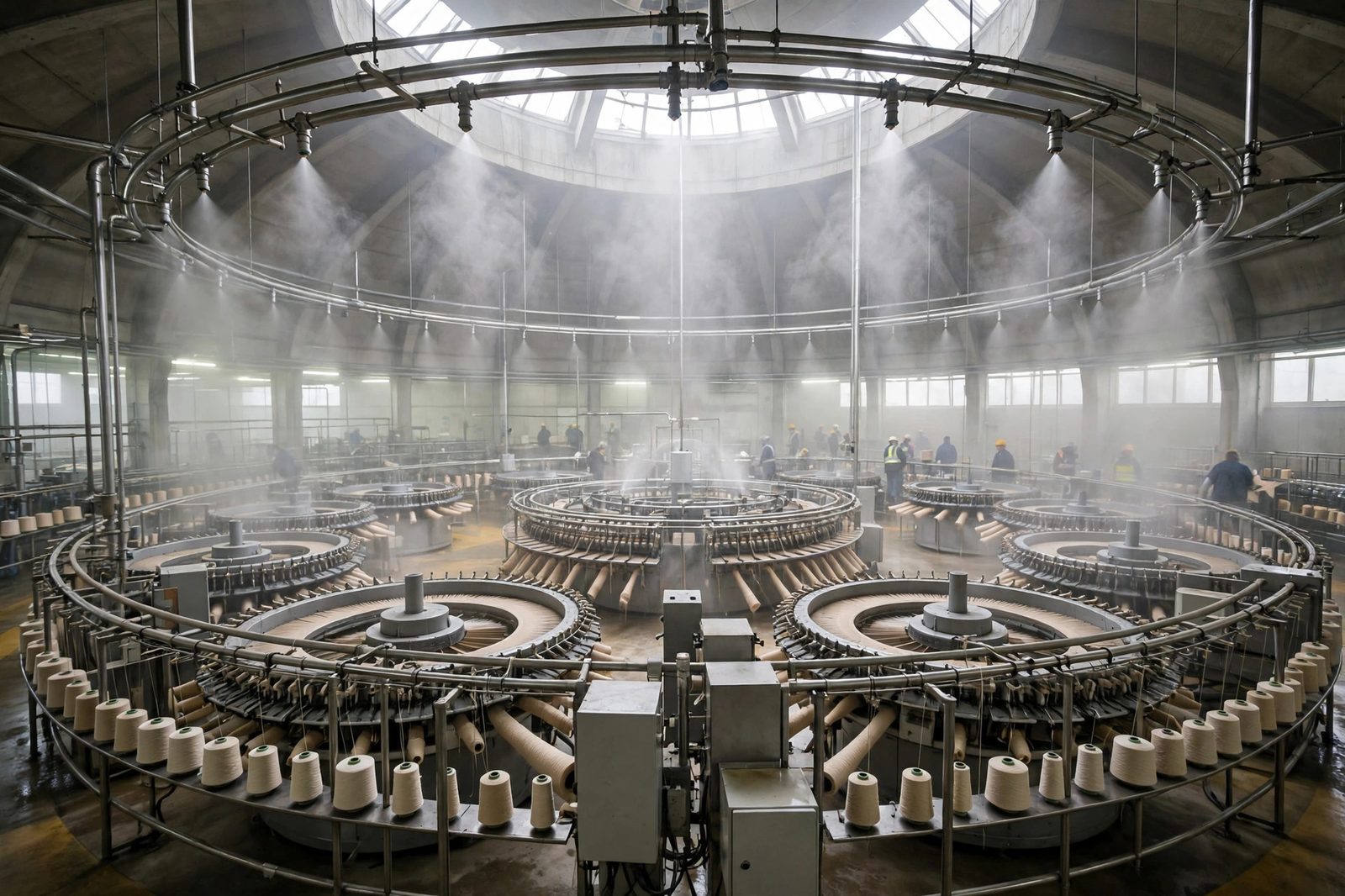
Direct answer: For a circular knitting hall running cotton or cotton-blend yarn in Bangladesh, hold relative humidity at 60–65% RH and temperature near 24–27°C. Below about 45% RH, static and yarn breakage climb sharply; above roughly 75% RH, roller lapping, needle corrosion and soggy yarn packages appear. Measure with calibrated wall sensors away from machines, log readings every shift, and humidify or dehumidify to stay inside the band year-round.Mount calibrated hygrometers at yarn-creel height (about 1.5 m), away from doors, humidifier nozzles and machine heat plumes. ISO 139's guidance reminds that measurement devices should be separate from the sensors used to control HVAC ducts.
Use at least one sensor per hall zone; large halls need several because humidity stratifies.
Log readings every shift and plot weekly trends — a slow drift tells you the humidifier pads or nozzles need service before breakage rates move.
Calibrate annually against a reference instrument; a sensor reading 5 points high silently wastes water and corrodes needles. Bond and ground all creels, feeders and machine frames; check earth continuity during preventive maintenance.
For high-synthetic programmes, consider anti-static bars at the yarn path — sprays and topical agents wash out and are only a stopgap.
Keep operator walkways and packing areas at similar RH; static built up downstream still contaminates finished rolls.
In winter, when indoor RH crashes, raise the humidification setpoint a few points before breakage data tells you to. Summer (Mar–May): heat plus dry spells — run humidification hardest, watch adiabatic cooling benefit, service pads before the season.
Monsoon (Jun–Sep): dehumidify; inspect for corrosion, keep yarn stores closed, drain condensate traps daily.
Winter (Nov–Feb): driest air of the year — raise RH setpoints, condition incoming yarn longer, watch static on synthetics.
Year-round: log RH/temperature per shift, review breakage-rate trends monthly, and fold humidity checks into the knitwear factory setup and commissioning plan so new lines are specified with control from day one. Controlling to a single wall thermostat while the creel zone runs 10 points drier.
Misting nozzles pointed at machines, wetting yarn packages directly.
Treating a humidifier as fit-and-forget: clogged nozzles silently drop output over months.
Chasing low breakage with ever-higher humidity until lapping and corrosion appear — there is an optimum band, not a maximum.
Ignoring the yarn store: conditioning only the hall leaves half the variation in place.
Why humidity decides knitting stability
Yarn is hygroscopic: it continuously trades moisture with the air around it. Three consequences follow directly in a knitting hall:Yarn strength and breakage. Cotton gains strength as it absorbs moisture because water weakens internal hydrogen bonding and lets fibres align under load. Industry references on conditioning note that sized cotton yarn held at 8–10% moisture content breaks less; dried-out yarn turns brittle and snaps at the feeders, needles and take-down. Every extra end-down stops the machine, wastes yarn and risks needle damage.Static electricity. Dry air is an insulator. Man-made fibres such as polyester and elastane accumulate charge when RH falls below about 45%, and humidification references note that holding around 50% RH largely eliminates static build-up. Charged yarn balloons, wraps rollers and attracts fly, which shows up as streaks and contamination in the fabric.Fly, dust and GSM drift. Correct humidity makes airborne lint precipitate instead of floating, and cold-water humidification adds 2–6°C of adiabatic cooling as a side benefit. Moisture regain also moves fabric weight: cellulosic fibres hold 7–11% moisture under standard conditions, so GSM readings drift with the weather unless the hall is controlled.Target humidity and temperature ranges
There is no single universal number; different zones of the mill need different bands. Use these as starting points and confirm with your own breakage logs:| Zone | Temperature | Relative humidity | Why | |---|---|---|---| | Circular knitting hall (cotton) | 24–27°C | 60–65% RH | Balances yarn strength against roller lapping | | Knitting hall (synthetic / elastane blends) | 24–27°C | 55–60% RH | Lower band limits static without swelling yarn | | Yarn store and conditioning area | 20–27°C | 65% RH | Matches ISO 139's 20°C / 65% RH standard atmosphere used for textile testing | | Dyeing and finishing feed | per process | 55–65% RH | Prevents over-dried greige entering wet processing |The ISO 139 standard atmosphere (20.0°C ± 2°C, 65.0% RH ± 4%) is the reference the whole textile trade uses for testing; a tropical variant is defined at 27°C / 65% RH. Your knitting hall does not need laboratory tolerances, but aiming near these bands keeps yarn behaviour predictable. Mill surveys published by Fibre2Fashion report comparable practice: 50–55% RH in card rooms, 50–60% in ring spinning and 60–65% in winding — the knitting hall sits at the upper end because the yarn is under direct mechanical stress at the needles.What goes wrong at the extremes
| Symptom | Likely cause | Check first | |---|---|---| | Rising yarn breaks, brittle feel | RH below ~45% | Hall sensors, humidifier output, winter dry air ingress | | Yarn ballooning, fly contamination | Static from low RH | RH log, grounding of creels, synthetic content | | Roller and needle lapping | RH above ~70% for cotton | Reduce humidification, check for over-misting near machines | | Needle and sinker corrosion spots | Sustained RH above ~75% | Dehumidify, improve ventilation, inspect water quality | | GSM varying shift to shift | Uncontrolled moisture regain | Condition greige rolls before weighing and dispatch |Measuring correctly
A control system is only as good as its sensors:Humidification and control methods for Bangladesh mills
Direct misting (compressed air + water spray). Rows of nozzles in the roof space release a fine mist that evaporates into the hall air. Droplet sizes around 7.5 µm behave almost like steam and do not wet the yarn. This is the most common retrofit for existing knitting halls in Bangladesh because it needs no ductwork.Evaporative pad systems. Air is drawn through wetted pads before entering the hall. Effective in the hot dry months (March–May in Bangladesh) and cheaper to run than chillers, but they add humidity even when you may not want it during monsoon.HVAC with dehumidification. For mills that can invest, a proper air-handling unit both humidifies in winter and dehumidifies during the monsoon, when outdoor RH can sit above 85% for weeks. Bangladesh's climate means most halls need humidification in the dry season and moisture removal in the monsoon — plan for both directions.Water quality. Use treated water for misting systems. Hard water leaves mineral dust on yarn and machine surfaces; untreated water breeds biofilm in tanks and pads.Yarn conditioning before knitting
Yarn arriving from a dry store or an air-conditioned truck is not at equilibrium. Give packages 24 hours in the conditioned yarn store before they reach the creel, and keep the store near 65% RH. Skipping this step means the first shifts after a delivery run on drier, weaker yarn while later shifts run on conditioned yarn — an avoidable source of shift-to-shift variation. For a deeper view of the mechanical side, pair this routine with the circular knitting machine maintenance guide.Static control beyond humidity
Humidity is the first defence, but not the only one:Seasonal checklist for Bangladesh
Common mistakes
Machine selection interacts with climate
Humidity control is part of the wider specification. When choosing cylinder diameter or working through the gauge selection guide, confirm the machine's operating envelope against your hall's real temperature and humidity range — electronics, lubrication and pneumatic systems all assume a stated climate.Assumptions and verification
This is an evergreen operations guide. It gives target bands and decision methods, not a commissioning certificate for any specific hall. Actual setpoints depend on yarn, machine type, building envelope and local climate; verify with your own sensor logs and breakage data. Test methods follow ISO 139 / ASTM D1776 conventions where cited. Before any capital purchase, use the pre-shipment inspection checklist to confirm the supplied humidification and control equipment matches the approved specification.FAQs
1. What is the ideal humidity for a circular knitting hall in Bangladesh?
For cotton and cotton blends, 60–65% RH at 24–27°C is the practical band most mills use. It keeps yarn strong and static low without pushing into the roller-lapping and corrosion zone above ~70–75% RH. Synthetic-heavy programmes run slightly lower, around 55–60% RH.2. Why does yarn breakage rise in winter?
Winter air in Bangladesh is the driest of the year. Low RH dries yarn below its equilibrium moisture, making cotton brittle, and lets static accumulate on synthetics. Both raise end-down rates. Raising the humidification setpoint and conditioning incoming yarn longer usually restores breakage to normal levels.3. Can too much humidity damage knitting machines?
Yes. Sustained RH above roughly 75% encourages fibre lapping on rollers and needles, corrodes steel components, and can leave yarn packages damp enough to grow mildew in storage. Control to a band with both humidification and (in monsoon) dehumidification.4. How do I know my hygrometer is telling the truth?
Calibrate annually against a reference instrument, mount sensors at creel height away from nozzles and heat sources, and cross-check two sensors in the same zone. If breakage rises while the display reads normal, suspect the sensor before the yarn.5. Is humidity control worth the investment for a small knitting unit?
Usually yes. A direct misting retrofit is modest in cost, and even a small reduction in end-downs, rework and GSM claims pays back quickly. Start with measurement — a calibrated logger for a month often reveals that the hall is far outside the band the owner assumed.Related Topics
humidity controlcircular knittingknit factoryBangladesh millsyarn conditioningstatic electricityfactory efficiencyআর্দ্রতা নিয়ন্ত্রণ
Need Technical Sourcing Assistance?
Request Machine QuoteConfigure Your Mill's Circular Knitting Line
Factory-direct pricing, CFR Chattogram delivery, pre-shipment quality audit, and local commissioning in Bangladesh.