
Maintenance & Parts•2026-10-16•Tasneem Editorial Desk
Circular Knitting Machine Yarn Tension Troubleshooting: Bangladesh Mill Guide
Uneven yarn tension across feeders causes yarn breaks, GSM drift, barre, and Lycra breakage. This guide walks Bangladesh mills through a step-by-step diagnostic: measuring feeder input tension, equalizing storage feeders, tracing the yarn path, checking packages, humidity, and take-down.
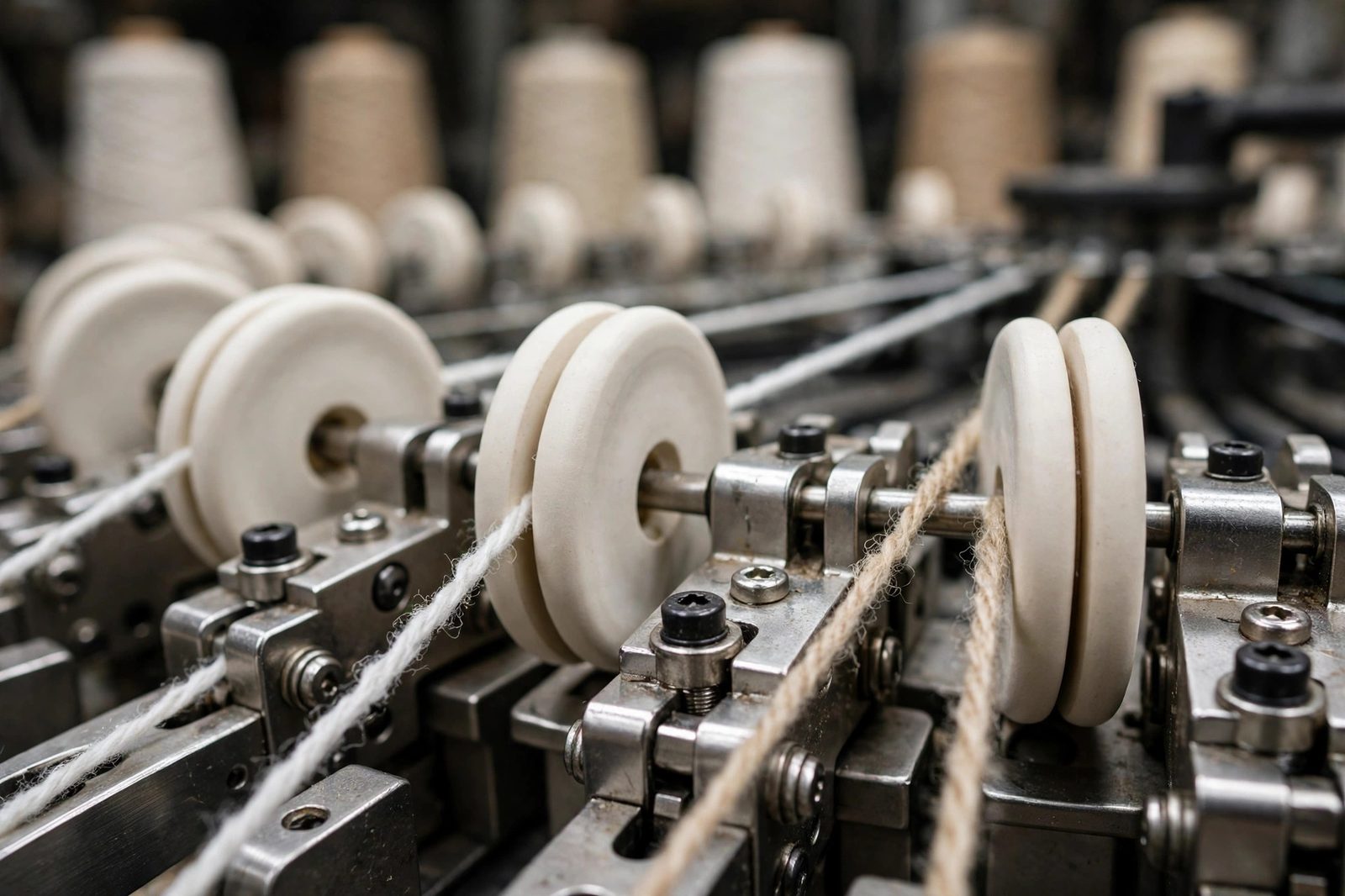
Circular Knitting Machine Yarn Tension Troubleshooting: Bangladesh Mill Guide
Direct answer: Uneven yarn tension across feeders is the most common hidden cause of yarn breaks, GSM drift, barre, and Lycra breakage on circular knitting machines. Tension is set by the creel, the feed system (negative or positive feeders), and the take-down. Troubleshoot by measuring every feeder with a hand tension meter, equalizing the readings, cleaning the yarn path, and checking humidity before changing machine settings.On a circular knitting machine, yarn tension is not a single knob — it is the combined result of three separate systems. The creel and yarn path deliver yarn from the package, the feed system (negative feed or positive storage feeders) meters it into the knitting zone, and the take-down pulls the finished fabric tube away. When any one of them is out of balance, the machine usually keeps running, but the fabric pays the price: drifting GSM, barre stripes, yarn breaks, and Lycra snapping. This guide gives Bangladesh knit mills a practical, step-by-step diagnostic sequence for circular knitting machine yarn tension troubleshooting, so you fix the root cause instead of compensating with settings.What yarn tension actually controls
Tension does not set the fabric weight directly — it controls how much yarn is delivered for each stitch. A tighter input tension stretches the yarn before the needle forms the loop, which changes loop length; a slacker tension lets more yarn flow into the stitch. Because loop length is the single biggest driver of fabric weight, small tension differences show up as GSM drift long before they cause a stoppage. Research on yarn input tension (YIT) control in circular knitting confirms that controlling input tension is important not only for producing the knitted fabric but also for detecting faults through tension monitoring (University of Minho, ICIT 2004). In plain terms: if your GSM is wandering and you have not touched the VDQ pulley, suspect tension first.Negative vs positive feed systems
Most circular knitting machines in Bangladesh use one of two feed arrangements, and the troubleshooting differs between them:Symptoms and what they point to
| Symptom | Most likely tension cause | Check first | |---|---|---| | Repeated yarn breaks at one feeder | Chipped ceramic eye, bent guide, knot catcher set too tight, worn storage wheel, that feeder's tensioner tighter than the rest | That feeder's yarn path and tensioner | | GSM drifting within a roll | Feeder-to-feeder input tension variation; package diameter decreasing on negative feed | Tension meter readings across all feeders | | Barre (horizontal stripes) | Unequal loop length between feed systems caused by uneven input tension | Feeder equalization, then VDQ pulley position | | Lycra/elastane breakage | Excessive elastane feed tension, dry or degraded elastane package, rollers slipping | Elastane feeder setting and package condition | | Frequent stoppages with no visible break | Stopper sensitivity, fly blocking the sensor, knot catcher stopping at every slub | Clean sensors, review stopper sensitivity | | Fabric tube ballooning or sagging | Take-down tension too slack or too tight | Take-down roller pressure and winding |The diagnostic sequence (do it in this order)
Step 1 — Measure, don't guess. With the machine running at normal speed, hook a hand yarn-tension meter at the same point on every feeder, just before the yarn enters the knitting zone. Write down each reading in cN (or grams). If readings scatter widely from feeder to feeder, you have found your problem before touching anything else. Equalize them first; only then evaluate fabric quality.Step 2 — Equalize the storage feeders. On positive feed machines, confirm every storage wheel is set to the same reference and that the drive belt is not slipping. A glazed or grooved storage wheel feeds differently from a clean one — clean the wheels with a dry cloth and replace wheels with visible grooves.Step 3 — Trace the full yarn path. Follow the yarn from cone to feeder: creel tube, tension discs, guide eyes, knot catcher, stopper. Look for chipped ceramic eyes, grooved guides, lint packed into tension discs, and fly wrapped around rollers. Every contact point adds friction, and friction is tension. A single rough guide can raise input tension at one feeder enough to cause breaks while the other feeders run fine.Step 4 — Inspect the yarn packages. On negative feed, a soft-wound or damaged package unwinds unevenly and spikes tension. Check that cones sit properly on the creel, that yarn unwinds over-end without catching, and that the package is not rubbing against its neighbor. Switch a suspect package to a different feeder — if the problem moves with the package, it is the package, not the machine.Step 5 — Check shed humidity and static. Dry air increases static charge and yarn-to-metal friction, which raises effective input tension and multiplies fly. ISO 139:2005 defines the standard textile atmosphere as 20.0 ± 2.0 °C and 65.0 ± 4.0 % relative humidity (with a tropical alternative of 27.0 °C and 65 % RH) — the same physics applies on the knitting floor. If your humidity control guide readings are far below the 65 % RH band, fix the shed climate before chasing tension settings.Step 6 — Check the take-down. The fabric tube should hang like a fully inflated balloon — not tight, not sagging. Excessive take-down tension stretches the fabric as it knits, which reads as low GSM and can snap elastane; too little take-down lets the tube fold and crease. Adjust the take-down roller pressure evenly and confirm the fabric winds without wrinkles.Step 7 — Cross-check with GSM. Cut a 100 cm² sample with a GSM cutter and weigh it. Compare against the target from your production capacity formula and style sheet. If GSM is off but all feeder tensions are now equal, only then adjust stitch length via the VDQ pulley — the pulley sets density deliberately, while tension faults set it accidentally.Step 8 — Record the baseline. Once the machine knits correctly, record the tension readings, storage wheel settings, stopper positions, and take-down pressure for that yarn count and fabric. The next changeover starts from these numbers instead of from scratch, which cuts setting time and kills the "it worked yesterday" mystery.When it is not a tension problem
Tension faults follow feeders; mechanical faults follow positions. If a defect appears at the same angular position on every revolution, or follows one needle regardless of which feeder feeds it, look at needles, sinkers, cams, and the cylinder — not tension. A bent needle or a chipped cam track will not respond to any tension adjustment, and no amount of feeder equalization fixes a damaged sinker. Knowing this distinction is what separates a ten-minute diagnosis from a full day of trial and error. For related machine choices that affect tension stability, see the gauge selection guide and the cylinder diameter guide.Prevention: a shift routine that works
FAQs
Why does yarn break at only one feeder when the others run fine?
Because the fault is local to that feeder: a chipped ceramic eye, a bent guide, a knot catcher set tighter than the rest, a grooved storage wheel, or that feeder's tensioner adjusted differently. Swap the package to a neighboring feeder — if the breaks stay at the same feeder, the feeder hardware is the cause; if they move with the package, the yarn is.Can tension differences between feeders cause barre?
Yes. Each feed system knits its own courses, so if feeders deliver different input tensions, each system forms slightly different loop lengths, and the fabric shows horizontal barre stripes. Equalize input tension across all feeders with a tension meter before suspecting the yarn or the VDQ pulley setting.How do I tell a tension problem from a mechanical fault?
Follow the pattern, not the symptom. Tension problems follow feeders and feed systems — they change when you move a package or adjust a tensioner. Mechanical faults follow positions — they repeat at the same angular spot every revolution regardless of feeder, and they point to needles, sinkers, cams, or the cylinder.Does low humidity really cause more tension faults?
Yes. Dry air raises static charge and yarn-to-metal friction, which increases effective input tension and generates fly that blocks stoppers and sensors. ISO 139:2005 sets the reference textile atmosphere at 20.0 ± 2.0 °C and 65.0 ± 4.0 % RH (tropical alternative 27.0 °C / 65 % RH); sheds running far below this band consistently show more breaks and stoppages.Should I fix GSM drift with the VDQ pulley or with tension?
Fix tension first, then use the VDQ pulley only to set the intended density. The VDQ pulley deliberately changes stitch length and therefore GSM; tension faults change it accidentally and unevenly. Adjusting the pulley to compensate for uneven tension locks the fault in instead of removing it.Related Topics
yarn tensioncircular knittingtroubleshootingpositive feedGSM controlসুতা টানসার্কুলার নিটিংমেশিন রক্ষণাবেক্ষণ
Need Technical Sourcing Assistance?
Request Machine QuoteConfigure Your Mill's Circular Knitting Line
Factory-direct pricing, CFR Chattogram delivery, pre-shipment quality audit, and local commissioning in Bangladesh.